


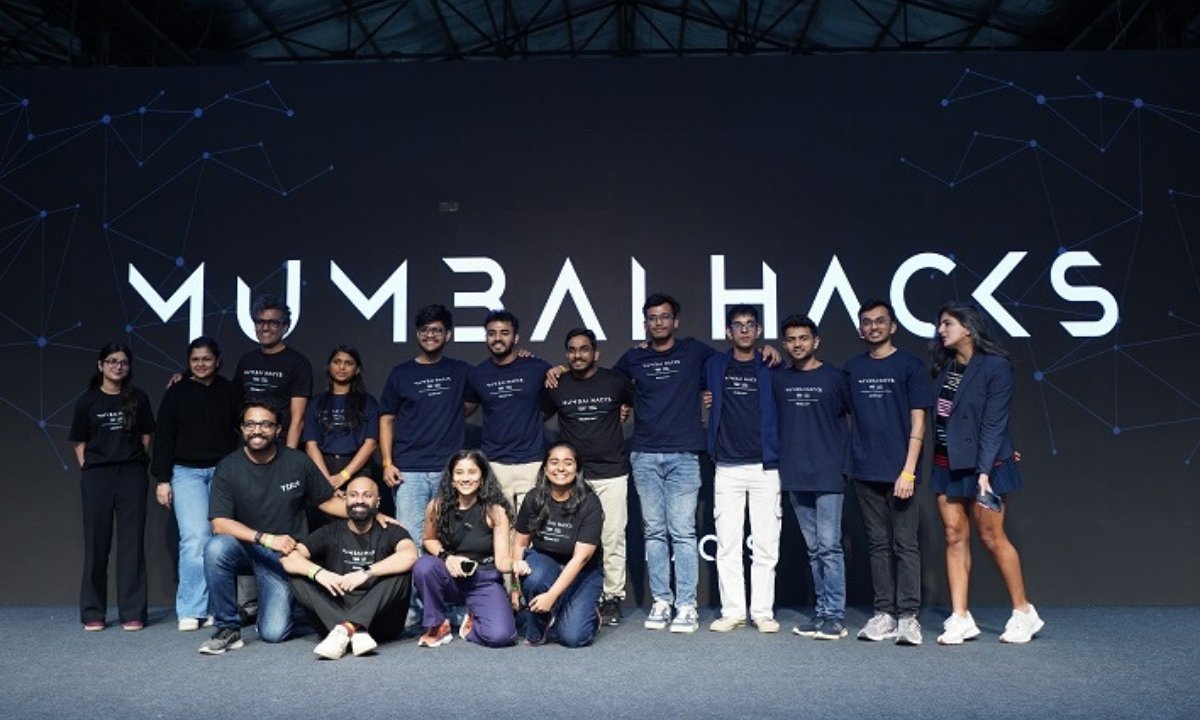
MumbaiHacks 2025 created history at NESCO, Mumbai, as it became the world’s largest Agentic AI hackathon with over 3,500 participants. Organised by the Tech Entrepreneurs Association of Mumbai (TEAM) and Made in Mumbai, and presented by HCLTech, the two-day event featured a total prize pool of ₹1 Crore in cash and rewards, firmly reinforcing Mumbai’s position as a fast-rising AI innovation hub.
The hackathon saw intense innovation across Fintech, Healthtech, and Misinformation Detection tracks. Over 900 women technologists, accounting for 27% of all participants, took part in the event.
All-Women Team from Mumbai Wins Misinformation Track
A defining moment of the event came when an all-women team from Mumbai—Sejal Chaudhari, Supriya Nayak, Shambhavi Patil, and Akritee Singh—won the Misinformation Track, highlighting the growing leadership of women in India’s AI ecosystem.
IDFC FIRST Bank Rewards Top 100 Teams
In a standout gesture, IDFC FIRST Bank’s MD & CEO, Mr Vaidyanathan, awarded ₹3,000 per team member to the top 100 teams, recognising the top 10% of all participants and underlining the bank’s commitment to fostering early-stage innovation.
Winners at MumbaiHacks 2025
Fintech Track
Winner: Moneyमित्र – An AI-powered personal finance platform for automated budgeting, transaction tracking, smart alerts, stock portfolio monitoring, and multilingual financial education.
Runner-Up: FinOps Copilot – An AI automation tool for fintech operations using natural language commands.
Healthtech Track
Winner: CardioSense AI – An Agentic AI-driven system for automated detection of Coronary Artery Disease using angiography videos.
Runner-Up: Nirogya – An AI healthcare platform offering symptom assessment, teleconsultation, medicine tracking, and epidemic monitoring.
Misinformation Track
Winner: Padhai Check – An Agentic AI study companion that verifies exam-related information and provides emotional support.
Runner-Up: The Miasma Filter – A real-time multimodal AI system that verifies claims across live broadcasts.
Star Jury and Grand Finale
The event was judged by industry leaders from HCLTech, GOQii, LoveLocal, Hungama, InShorts, IDfy, and V3Ventures. The closing ceremony featured Raghu Ram as chief guest and an address by fintech creator Sharan Hegde.
Vivek Khemani, Organizer, MumbaiHacks, said the event has evolved into a movement redefining Mumbai as India’s emerging AI capital.
Tyagarajan Iyer, Head of Operations & Technology, IDFC FIRST Bank, praised the energy, innovation, and entrepreneurial spirit of the participants.
Exclusive Interview: Dhruvil Sanghvi, Organizer, MumbaiHacks 2025
How do you see the AI landscape evolving in India over the next 2–3 years?
Over the next few years, India’s AI landscape is set to shift from experimentation to large-scale, real-world deployment. We’re moving from chatbots that simply converse to Agentic AI systems that can autonomously act, execute tasks, and solve population-scale challenges. Sectors like finance, healthcare, governance, and logistics will benefit the most from this, since India’s public digital infrastructure like Aadhaar, UPI, and ONDC creates a strong foundation for AI-led products.
We’re also entering a phase of “innovation density,” where the top talent pool of engineers, startups, and enterprises are working together. Large-scale events like MumbaiHacks are accelerating this shift by rapidly converting builders into startup founders. Going beyond AI adoption, India is now creating AI intellectual property for the world.
Which sectors in India are adopting AI most rapidly—finance, healthcare, logistics, or retail?
Sectors where decision-making, customer scale, and operations are primarily complex are the sectors where AI adoption is accelerating, and this primarily includes Fintech, Healthcare, Logistics, and Retail.
In FinTech, AI is being used extensively for fraud detection, credit scoring, customer support automation, and compliance areas where speed and accuracy directly impact business outcomes. Healthcare is seeing rapid adoption through diagnostic support, triage systems, workflow automation, and patient record digitisation. Logistics and supply chain companies are increasingly depending on AI for route optimisation, demand forecasting, and warehouse automation, especially as e-commerce expands. In Retail, AI now powers everything from personalised recommendations to store planning and demand prediction.
Across all these verticals, companies are moving away from basic pilots and shifting to AI systems that can automate repetitive tasks, reduce operational inefficiencies, and improve customer experience at scale.
MumbaiHacks is now becoming the world’s largest Agentic AI hackathon with 3,500+ participants. What is driving this massive interest and momentum?
The piqued interest around MumbaiHacks comes from a genuine shift happening in the builder community: engineers, students, and early-stage founders want hands-on experience with real-world AI problems. Agentic AI, in particular, is attracting attention because people want to build systems that can actually do things autonomously, not just answer queries. Apart from this, a substantial percentage of the momentum comes from the credibility MumbaiHacks built last year after setting a Guinness World Record; it showed participants that this is a serious, high-quality platform with strong industry involvement.
This year, the hackathon partnered with startups, enterprises, and mentors who gave real datasets, actual problem statements, and guidance. That combination of learning, visibility, and potential hiring or investment outcomes makes MumbaiHacks much more than a competition; it becomes a goldmine of opportunity for career development and networking. For many, it is also a chance to showcase skills, find co-founders, or even validate startup ideas in front of decision-makers. That is what is driving the surge in participation.