


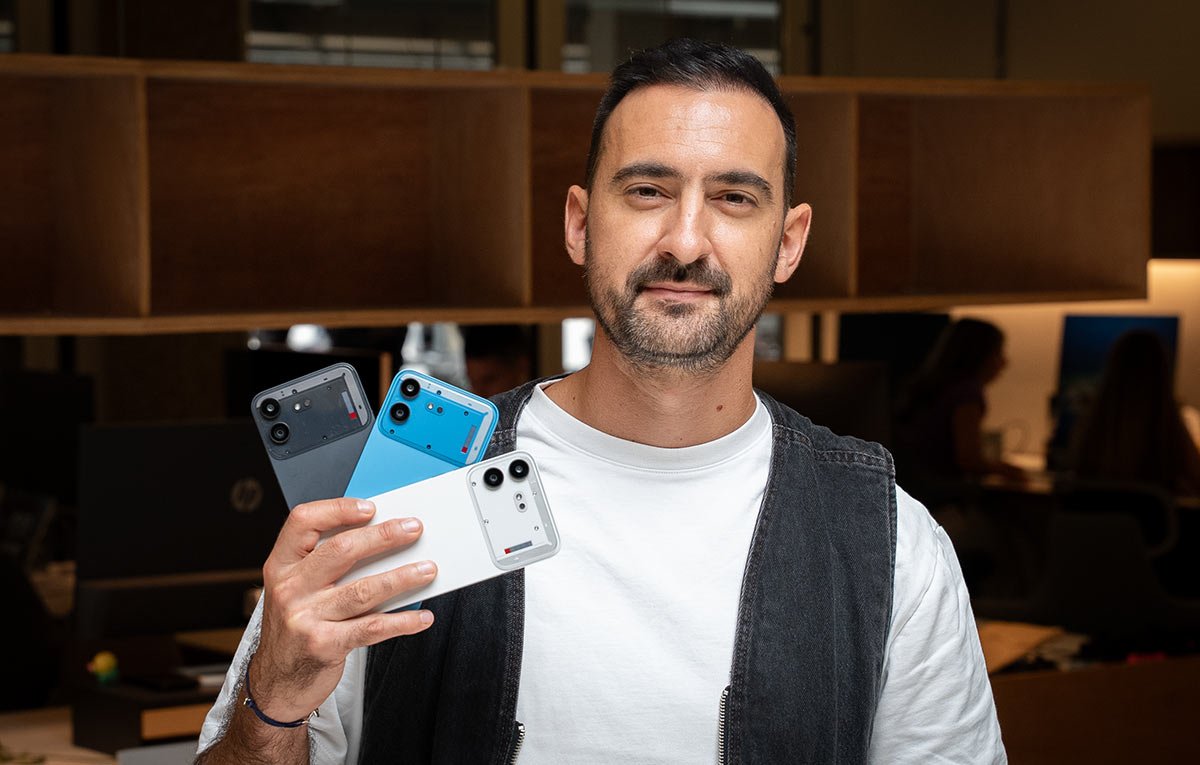
As Co-founder of Nothing, Akis Evangelidis has challenged one of the world’s most competitive industries by proving that a new consumer technology brand can still break through. From rethinking smartphone design to questioning the way people interact with technology, his philosophy has always been rooted in challenging convention rather than following it. In this edition of Tech Titans, Evangelidis shares why decisive action often beats endless deliberation, how moving continents as a teenager shaped his leadership, and why he believes the biggest mistake companies are making with AI is treating it as just another feature. He also reflects on building Nothing against the odds, creating products that respect users’ attention instead of competing for it, and the long-term ambition of making technology feel more human than ever before.
What’s a personal habit or ritual that quietly shapes how you make big decisions?
My ritual for decisions is usually the 5-second rule: moving from intuition to action before doubt can take root.
Clarity comes from output, not over-analysis. A lot of it is driven by gut feeling, which is actually the subconscious synthesis of years of experience. By acting fast, I protect that expertise from the friction of hesitation.
This mindset was vital in the early days of Nothing. If we had stopped to weigh the odds, we never would have moved forward. Five years later, that bias for action has turned a long shot into a unicorn.
I view any delay as a form of “Simple Sabotage.” The tactics once used by wartime saboteurs to dismantle organizations – endless committees and “further study” – are now common corporate habits. I use speed to eliminate that stagnation. I don’t think my way into a solution; I do my way there.
What’s one childhood incident that shaped who you are today?
At 15, I moved from Marseille to New Jersey – a transition that forced a total identity reset. In France, I was a careless teenager, a troublemaker thriving on social life but lacking any real direction. When my father dropped me into a traditional American high school without a word of English, the “fun” stopped.
That sudden loneliness became my greatest asset. With no social circle to lean on, I spent my time reflecting, experimenting, and doubling down on sports. I replaced my carelessness with a rigorous, competitive discipline. Moving to the U.S. didn’t just change my environment; it stripped away the noise and forced me to build the self-awareness I rely on today.
What are your thoughts on Gen Z work culture, and how do you shape your work style to align with them?
The traditional corporate playbook is dead for Gen Z. They aren’t motivated by hierarchy; they are motivated by impact and authenticity. Because they have such a high “BS detector,” I focus on providing a clear mission and the autonomy to execute it. At Nothing, I expect them to bring a lot to the table – they are our primary audience, so they should be the ones coming up with a lot of ideas, especially marketing. However, autonomy requires guardrails. Without a clear framework, momentum can quickly veer off course.
What’s the biggest lie the industry is telling itself about AI right now?
The biggest lie in the industry right now isn’t misinformation; it’s the belief that AI is just another “feature” to be tacked onto existing products. We are seeing a wave of “AI-washing”, where companies are “AI-ing” everything, creating a lot of confusion for end users without realising that we are witnessing a fundamental shift in the human baseline.
People haven’t yet grasped that this is a tectonic change. Just as electricity and the internet redefined every aspect of our lives, AI will fundamentally rewrite the way we leverage technology and organise society. It isn’t just a tool we use; it is the new infrastructure we will build everything on top of.
What problem in the world still frustrates you enough to keep you awake at night?
Today’s tech is a betrayal. Instead of providing clarity, it thrives on “attention vampirism” and doomscrolling. I believe the AI era will finally steer us back to utility. We are building toward an ecosystem where the interface is seamless – integrating voice, gesture, and even neural control – so that our lives no longer revolve around a glowing rectangle in our pockets. The goal is an operating system that empowers us in the background, allowing us to reclaim our attention and move toward a world where technology serves the human, not the other way around.
What’s a decision you made that looked risky at the time but turned out right?
Starting Nothing. On paper, building a new consumer tech brand from scratch is less of a ‘business plan’ and more of a fever dream. The industry is a graveyard of failed startups; in fact, no new smartphone brand has successfully broken through in the last decade. It looked completely irrational in a way, but I guess until it didn’t…
Fast forward to today: Nothing is a unicorn and we’ve been India’s fastest-growing brand for 8 out of the last 9 quarters. But at the same time it feels like day-one as we’ve just scratched the surface, I am very excited for everything that’s to come. We are not slowing down any time soon.
What brands of gadgets do you use every day?
My daily setup is actually quite simple: the Phone (4a) Pro and the Ear (open). I’m particularly obsessed with the Ear (open); I keep them on all day because they allow me to jump in and out of calls while staying fully present in the room. It’s that balance of being connected without being isolated. I’ve experimented with various health-tracking wearables, but I haven’t found one that sticks yet. There is still so much room for innovation in that space.
When people look back at your work decades from now, what do you hope they say you changed?
I hope they say we were the ones who finally put the ‘human’ back into technology. Decades from now, I want our work to be remembered as the turning point where devices stopped competing for our attention and started enhancing our intent. We didn’t just build gadgets; we changed the relationship, making technology feel intentional, seamless, and above all, inspiring again.
What’s harder: taking a bold decision or sticking with it when things go wrong?
Sticking with it, without question. Taking a bold decision is an act of intuition, but staying the course is an act of will. I’ve always believed that if you want a bold decision to work, you can’t have a Plan B – it only serves as a distraction from making Plan A a reality. The real challenge isn’t the initial leap; it’s the relentless, day-to-day navigation and course-correcting required to drag that vision into existence when everything is going wrong.
What part of AI genuinely excites you, and what part quietly worries you?
The excitement for me is in the efficiency; AI can return vast amounts of mental bandwidth to the workforce. The worry is the oversight. We need a robust framework for responsible control to ensure this technology stays aligned with human interests.
Rapid Fire
- Books you swear by:
- 1. Build “I wish this had existed before we started Nothing. It’s the “missing manual” for hardware. It cuts through the fluff and tells you exactly how to build iconic products and high-performance teams.
- 2. The Hard Thing About Hard Things “Most business books are written for “peacetime.” This is the only one that captures the raw reality and the struggle of navigating a company when there are no easy answers.”
- 3. Zero to One “The blueprint for being contrarian. It’s the best framework for understanding how to build a company that creates a new future rather than just competing in an old one.”
- 4. Shoe Dog “A reminder that every global giant was once a chaotic, cash-strapped startup. It’s the ultimate story of survival and the relentless pursuit of a vision.”
- Current car: I actually don’t drive
- Dream car/bike: Aston Martin DBS Superleggera
- Go-to AI tool: OpenClaw
- Quote you live by: “Go big or go home.”
- Podcast recommendations: Founders and Acquired are essentials. For AI, I recommend Limitless; it’s not very well-known yet, but it’s excellent at keeping up with the speed of the industry.