

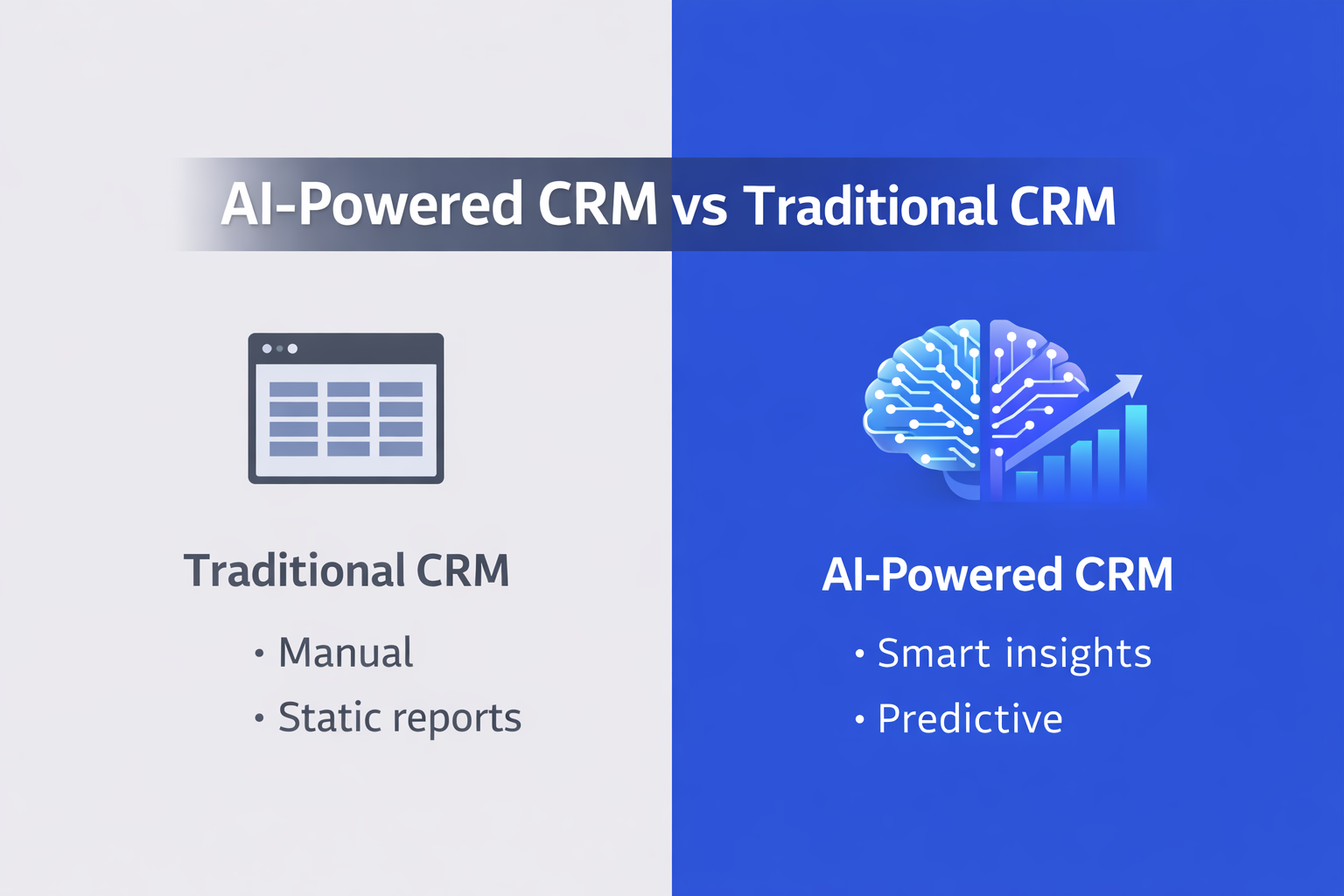
The customer relationship management platforms have been the key tools to organize contacts, monitor interactions and serve sales and service teams. Conventional CRM systems, however, were mostly oriented as online filing cabinets, which require manual input and ready-made rules. These systems cannot keep up with the increased expectations of customers and the increase in the volume of data. AI powered CRMs are a revolution as they apply machine learning and automation to actively aid decision making. They do not merely keep information organized, but instead, they identify patterns, forecast results, and suggest measures that can make organizations work smarter and act quicker.
Data Interpretation
Real time data interpretation is one of the biggest differences between the AI powered CRM and the traditional systems. Traditional platforms use predetermined filters and metrics, which predetermine the use of a report that is non-interactive. This is usually restrictive in understanding what teams already know to seek. AI powered platforms constantly examine customer behavior in the channels, defining patterns and anomalies, which could otherwise be obscured. This will enable organisations to understand customer needs in a better way as they change.
In addition to simple reporting, AI-driven CRMs will be able to convert raw data into intelligible information. These systems are able to predict customer intent and lifetime value by analyzing historical interactions, past purchases, and activity signals. As an example, an AI CRM can draw attention to the most likely to convert leads or the customers who can be at risk of churn. This kind of foresight cannot be offered by traditional systems since they do not have the capability of learning and responding to historical and real time data patterns.
Automation and Efficiency
The conventional CRM systems tend to rely on manual processes and strict automation policies that need maintenance at all times. They are able to automate simple processes, like the one related to the sending of follow up emails, but fail to cope with more complicated processes, which require context and judgment. AI powered CRMs go a step higher in automating tasks in real-time depending on the evolving conditions. They are able to prioritize activities, propose best next steps and even write individual messages without having human supervision.
Such a degree of automation enhances efficiency in teams in a considerable manner. The sales reps will have fewer and fewer hours on updating the records and spend more time with the customers, whereas the service teams will be able to fix the problems much quicker due to smart routing and response recommendations. In professional applications, e.g., CRM for financial advisors, AI can be used to facilitate the process of client reviews, the identification of significant events in their lives, and the timely communication with clients. Conventional systems are not flexible to accommodate such finer workflows of scale.
Individualization and Interaction
Another dimension in which AI driven CRMs are more effective than traditional platforms is personalization. Elderly systems usually divide the customers into a limited number of characteristics that are not client-specific and therefore send generic messages that may not appeal to the customers. The platforms powered by AI examine specific behavioral data in order to provide the most personalized experience. They are able to make suggestions, content, and outreach time depending on the preferences and prior interactions of a particular customer.
This boosts personalisation resulting in increased engagement and more trust. Relevance and timeliness of communications are more likely to cause customers to react positively. The AI-driven CRMs do not stop perfecting their own personalization strategies on how to respond to the customers, as well. The feedback driven improvement is impossible to be realized in traditional CRMs since they are run by fixed rules instead of adaptive learning frameworks.
Prediction and Decision Support
The most dramatic potential of AI-driven CRM is, perhaps, predictive decision support. The traditional systems only give past data but leave the interpretation and planning all to the users. Predictive analytics, on the other hand, are AI-driven platforms that are used to make strategic decisions. They are able to forecast future earnings, recognize new opportunities as well as model the effects of various moves.
This predictive ability helps in planning and risk management within the organization. Leaders are in a position to make sound decisions using data driven predictions, and not just intuitions. The system improves with time since it is sensitive to outcomes. Conventional CRM platforms are not able to provide this dynamic guidance since they are not that smart to forecast and adjust to new situations.
Conclusion
AI based CRM is a definite breakthrough to the shortcomings of conventional systems. They help organizations to work more intelligently and more swiftly by interpreting information in a smart way, automating complicated processes, personalized interaction, and helping in making decisions that are quite predictive. Although traditional CRMs are still applicable in straightforward record keeping, they are not as adaptive as the modern AI guided platforms. The use of AI enabled CRM is becoming more than an asset, but a requirement as businesses strive to have a better understanding of their customers and achieve more efficient operations.