

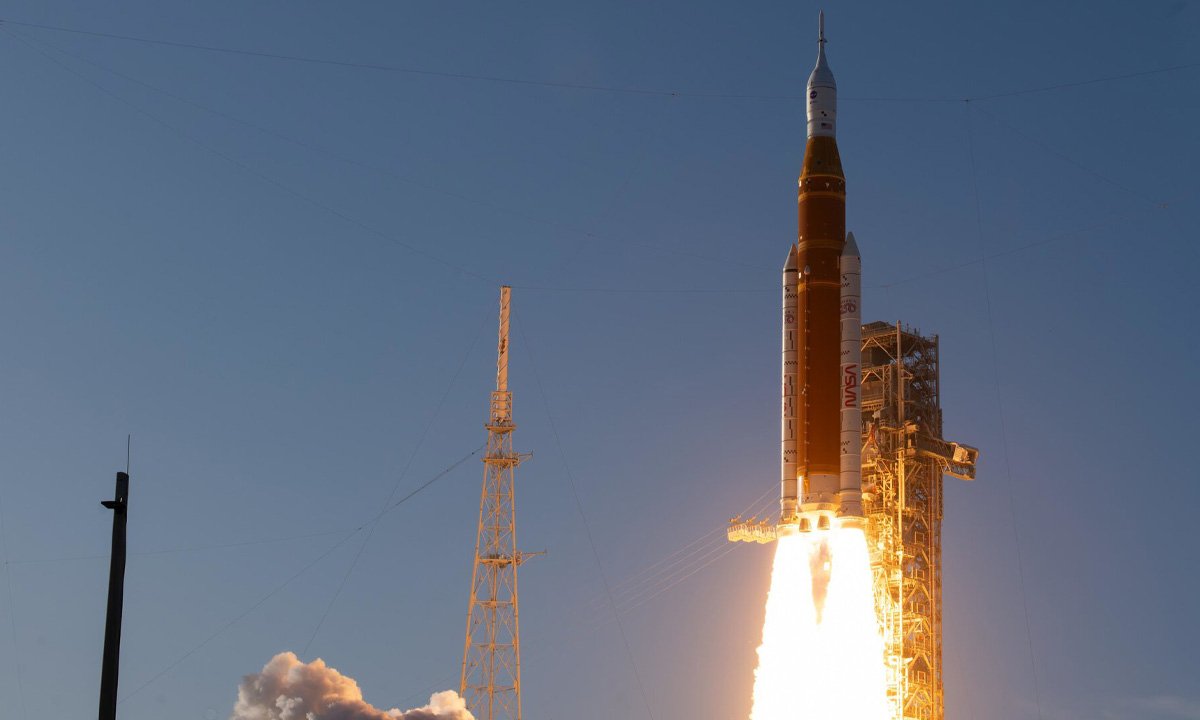
Humanity has officially taken its next giant step toward returning to the Moon. The long-anticipated Artemis II mission has successfully launched, marking the first time astronauts have embarked on a journey toward lunar space since the Apollo era more than five decades ago.
Launched aboard the colossal Space Launch System rocket from Kennedy Space Centre, the mission carries four astronauts inside the Orion spacecraft on a historic deep-space voyage. The launch represents a defining milestone for NASA and its international partners as the Artemis program moves from testing to crewed exploration.
Unlike a lunar landing mission, Artemis II will send the crew on a sweeping journey around the Moon before returning to Earth. Over the course of roughly ten days, the spacecraft will travel nearly 400,000 kilometres from Earth, performing a free-return trajectory that loops around the Moon and brings the astronauts safely back home. The mission is designed as the first crewed test of the Orion spacecraft’s systems in deep space.
The crew includes Commander Reid Wiseman, Pilot Victor Glover, Mission Specialist Christina Koch, and Mission Specialist Jeremy Hansen of the Canadian Space Agency. The mission also represents several historic milestones: Koch will become the first woman to travel to lunar space, Glover the first Black astronaut to do so, and Hansen the first Canadian astronaut to journey around the Moon.
Beyond its symbolic significance, Artemis II is a critical systems test. Astronauts will evaluate life-support systems, spacecraft navigation, communication with Earth, and human performance in deep space—capabilities essential for future lunar landings.
The mission paves the way for Artemis III, which aims to land astronauts near the Moon’s south pole later in the decade. With Artemis II now underway, the new era of lunar exploration has truly begun.