

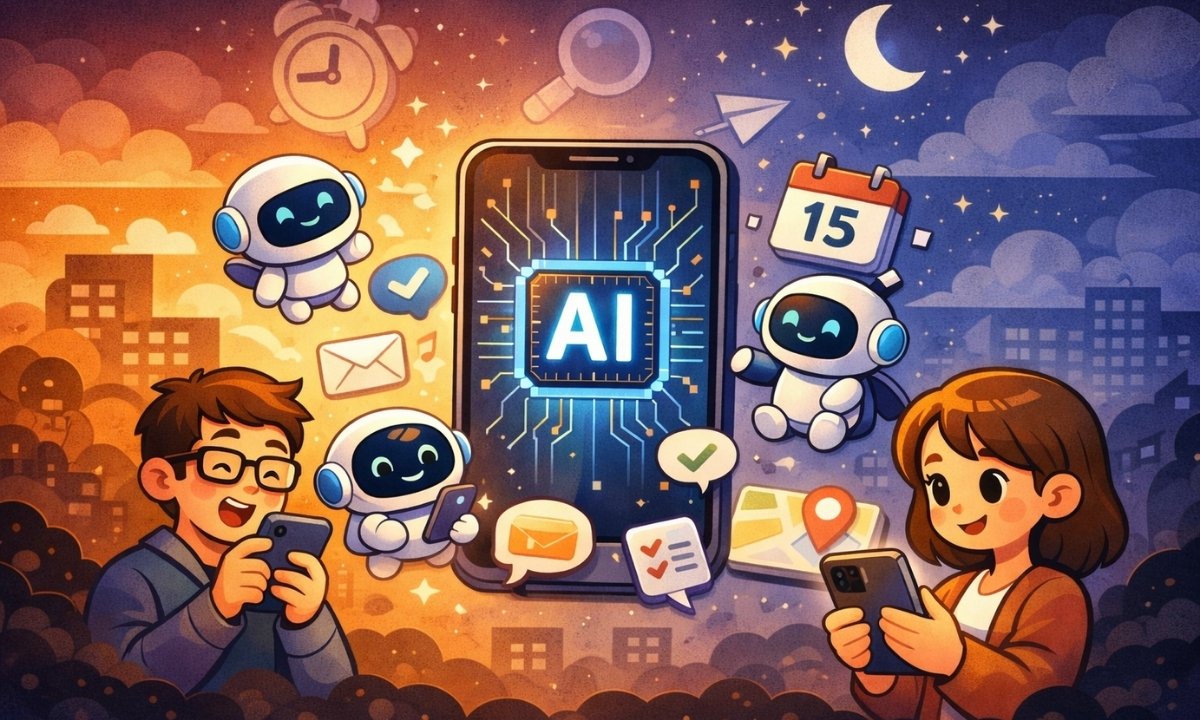
There was no keynote moment in 2025 where smartphones loudly declared themselves “AI-first.” No dramatic reveal. No single update that flipped a switch overnight. Instead, the transformation happened quietly, almost invisibly, until one day it felt normal.
I noticed it in small ways. Fewer manual steps. Fewer taps. More moments where my phone seemed to understand what I needed before I asked. What once felt impressive slowly became expected. That quiet shift is what truly defined smartphones in 2025.
This was not a year of flashy hardware experiments or buzzword-heavy software launches. It was the year artificial intelligence faded into the background and reshaped how smartphones behaved. AI stopped being something you searched for and became something that simply worked.
From activated AI to ambient intelligence
Just a year ago, AI on smartphones felt deliberate. You opened a specific app, typed a prompt, waited for an answer, and closed it. The interaction was intentional and obvious.
In 2025, that relationship changed. AI no longer asked to be engaged. It began working alongside users, shaping experiences quietly and continuously. Instead of demanding attention, it blended into everyday interactions, guiding them without announcing itself.
Smartphones didn’t become smarter in a dramatic sense. They became more aware, more responsive, and more aligned with how people actually use their devices.
When phones stopped asking and started assuming
One of the most noticeable shifts this year was how smartphones began making small, context-aware assumptions. Not reckless guesses, but thoughtful decisions designed to reduce friction.
You would unlock your phone and find information already organised in a useful way. A reminder appeared before you remembered to create one. A task felt half-complete before you realised you had begun it.
These moments were subtle, almost easy to ignore, but together they changed daily behaviour. Phones became less about instructions and more about anticipation. They learned patterns over time and used that understanding to predict what came next.
Once this behaviour became familiar, going back to manual steps felt unnecessarily heavy. The adjustment was quiet, but the impact was lasting.
From apps to connected experiences
As AI-driven behaviour became more common, smartphones stopped feeling like collections of isolated apps. Instead, they began functioning as cohesive systems.
A message could seamlessly turn into a document. A screenshot could become a reminder. Information no longer sat still inside apps; it flowed naturally between them.
This sense of continuity reduced mental effort. Users spent less time thinking about where something lived and more time simply completing tasks. The phone became less about launching tools and more about maintaining momentum.
Over time, the device itself began to fade into the background, which may be the clearest sign of progress. Smartphones didn’t disappear, but they became quieter, less demanding, and easier to live with.
The comfort and tension of convenience
With this ease came a new kind of relationship between users and their phones. Devices felt more attentive and accommodating, filling gaps and smoothing transitions throughout the day.
Convenience stopped feeling like a bonus feature and became the default. Daily interactions required less effort, fewer interruptions, and less friction.
However, this comfort came with an unspoken trade-off. For smartphones to understand context, they needed access to habits, routines, and behavioural patterns. Even when nothing felt intrusive, there was a growing awareness that more of everyday life was being observed and processed quietly in the background.
Most of the time, users accepted this balance. The experience was calmer and more intuitive. Still, moments of over-eagerness served as reminders that convenience and control don’t always align perfectly.
What smartphones truly learned in 2025
Looking back, 2025 wasn’t the year smartphones became dramatically more powerful. It was the year they became more considerate.
They learned when to assist and when to stay silent. They learned how to support without interrupting. They learned that the best technology doesn’t demand attention, it respects it.
The most meaningful changes never appeared on specification sheets or feature lists. They existed in the spaces between actions, in moments where technology stepped back instead of stepping forward.
And that may be the biggest shift of all. When smartphones become easier to live with rather than louder to notice, they stop feeling like tools and start becoming part of the natural rhythm of everyday life.