

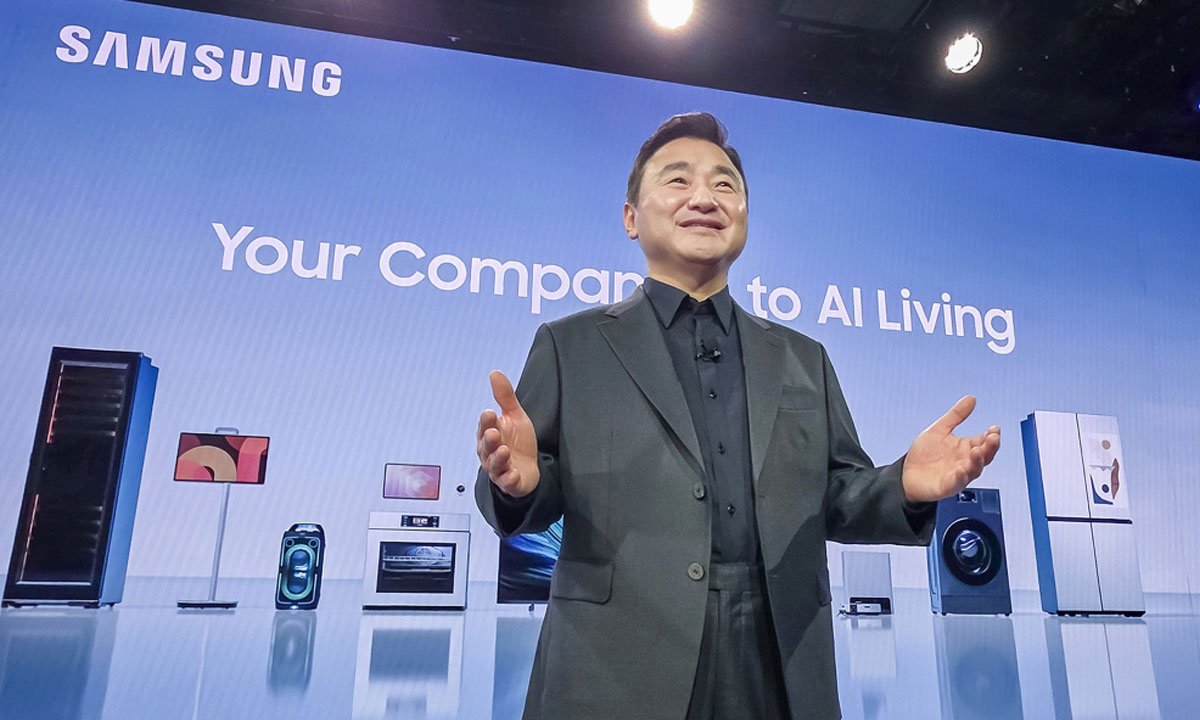
At its annual CES showcase, Samsung Electronics outlined a broad vision for how artificial intelligence will shape everyday consumer technology over the next few years. Presented at The First Look event during CES 2026 in Las Vegas, the company framed AI not as a feature set, but as an underlying layer connecting its phones, televisions, appliances, services and health platforms.
Opening the event, TM Roh, CEO and Head of Samsung’s Device eXperience division, positioned AI as the connective tissue of Samsung’s ecosystem. With hundreds of millions of SmartThings users worldwide, the company believes it has the scale to move beyond reactive smart devices toward systems that anticipate user needs across the home, workplace and personal health.
A major focus was Samsung’s display business, where AI is being used to reshape how users interact with televisions and entertainment devices. The company showcased its latest AI-powered TV lineup, headlined by a 130-inch Micro RGB display designed to push boundaries in colour accuracy and screen size. Alongside hardware advances, Samsung introduced its Vision AI Companion, which uses contextual understanding to assist with content discovery, sound tuning, and even lifestyle-related prompts such as recipes or music suggestions, depending on what is playing on screen.
The AI-led approach extends across Samsung’s broader TV portfolio, including OLED, Neo QLED and UHD models, all of which will support the company’s latest software platform. Samsung also confirmed that its 2026 televisions will be the first to support HDR10+ ADVANCED, alongside the rollout of its new spatial audio format, Eclipsa Audio. A notable long-term commitment is seven years of Tizen OS upgrades, positioning software longevity as a key pillar of the company’s TV strategy.
Beyond the living room, Samsung detailed how AI is being embedded into home appliances to reduce daily friction. Smart refrigerators equipped with upgraded AI Vision technology can now better track food items, suggest meals, and generate weekly food insights. In the laundry and garment care space, AI-powered washer-dryer combos and steam-based clothing refreshers aim to automate tasks that traditionally demand time and manual intervention. Robotic cleaners, meanwhile, are evolving into multi-purpose home assistants capable of navigation, monitoring and conversational control.
Samsung also used CES 2026 to outline its ambitions in digital health. By linking smartphones, wearables and home devices, the company plans to shift care from a reactive model to a preventive one. AI-driven insights could support sleep improvement, fitness guidance and early detection of health anomalies, with data securely shared with healthcare providers when required.
Underlying all of this is a renewed emphasis on security. Samsung reiterated that its Knox and Knox Matrix platforms will continue to evolve alongside AI systems, focusing on protecting user data across devices, networks and AI training processes.
Taken together, Samsung’s CES 2026 announcements point to a strategy centred on ecosystem depth rather than standalone products, with AI positioned as a quiet but persistent companion woven into everyday life rather than a headline feature.