

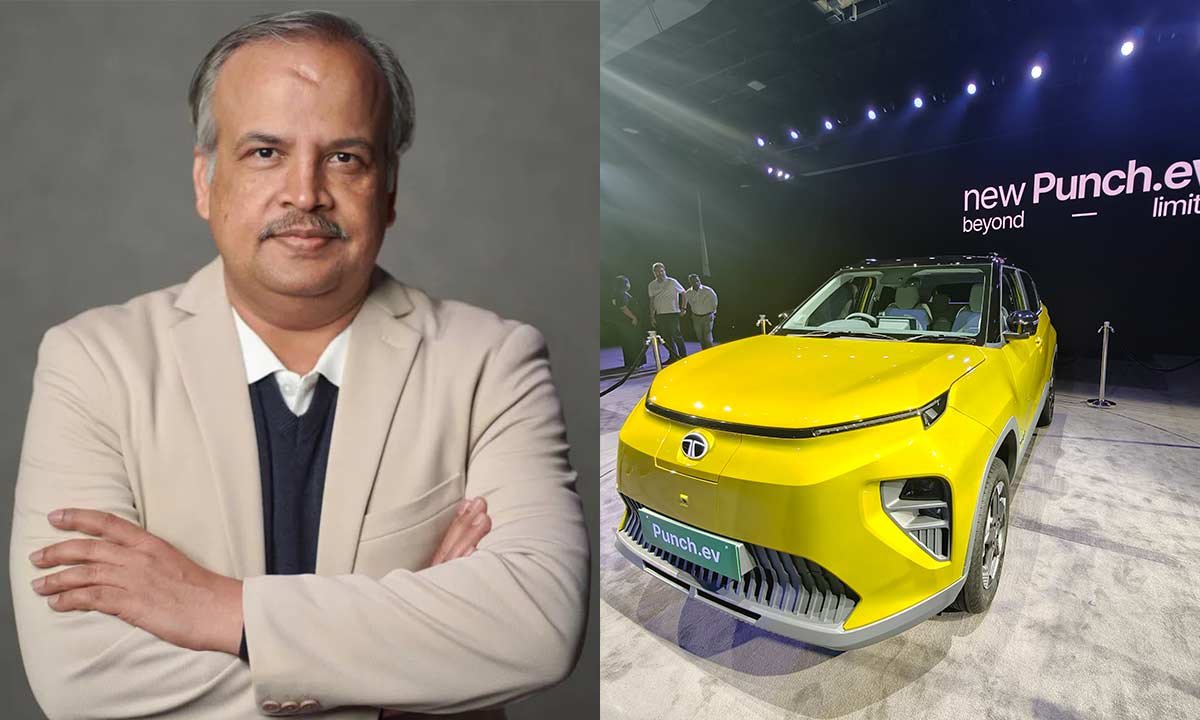
I sat down with Anand Kulkarni, Chief Products Officer, Head of HV Programs and Customer Service, Tata Passenger Electric Mobility Ltd., to discuss the evolution of the Punch EV, the engineering decisions behind its latest updates, and the brand’s broader electric mobility roadmap. From real-world customer feedback to battery technology, torque calibration and future-ready EV innovations, the conversation offered insight into how Tata Motors is refining its electric portfolio for a more mainstream Indian audience.
SN: What feedback from early user clinics or pre-launch trials influenced the final feature set of the Punch EV?
AK: The Punch EV was launched two years ago as our first product on the Acti.ev platform architecture. Since then, we have expanded the platform to models such as the Harrier EV and the updated Nexon EV. To date, we have approximately 38,000 Punch EVs on the road, generating substantial real-world feedback.
Customers appreciate the vehicle’s performance relative to its size and format. However, three key areas of feedback stood out.
First, users wanted a greater range to make the Punch EV viable as a primary or sole family car.
Second, they sought faster charging capability to enable comfortable inter-city travel.
Third, they wanted improved accessibility.
In response, we introduced a lightweight, highly integrated Electric Drive Unit (EDU), which reduces space and weight. The saved weight has been reallocated to increase battery capacity to 40 kWh.
With improved efficiency and the larger battery pack, the real-world C75 range — defined as the range achieved by 75% of users in typical driving conditions — now stands between 335 and 355 kilometres.
Charging speeds have also been enhanced. A 20–80% charge can now be completed in under 27 minutes, enabling approximately 135 kilometres of added range in a short session. This significantly improves highway usability.
To address concerns around battery life and long-term ownership, we are offering a lifetime warranty on the 40 kWh battery pack. This provides assurance on battery health and longevity.
In addition, we have introduced further value enhancements, details of which will be shared during the product presentation.
SN: With the car about to launch tomorrow, how has its torque delivery been calibrated? Is it tuned more for instant acceleration or smoother city drivability?
AK: The Punch EV continues to offer three drive modes: Eco, City, and Sport. Each mode features distinct torque calibration. Sport mode delivers sharper, more immediate acceleration, while City and Eco modes provide smoother, more progressive responses suited to urban or efficiency-focused driving.
SN: What kind of regenerative braking logic is built in? Is it adaptive based on driving style?
AK: The vehicle offers four levels of regenerative braking, adjustable via paddle shifters on the steering wheel — Level 0, 1, 2, and 3. Each level provides a fixed regeneration intensity, allowing drivers to adapt based on traffic conditions. The regeneration progression is smooth rather than abrupt, ensuring consistent and comfortable drivability.
SN: What next-generation technologies (e.g., solid-state batteries, bidirectional charging) are you exploring for future Tata EVs?
AK: Bidirectional charging technology has already been demonstrated, beginning with the Curvv EV, where the battery can power auxiliary loads. Regarding next-generation battery technologies such as solid-state systems, these remain in advanced validation stages across the industry. As with any responsible automaker, we actively evaluate emerging technologies. However, large-scale introduction will depend on maturity, commercial viability, and suitability for our use cases.
SN: What warranty and battery health programs will be offered with the Punch?
AK: The Punch EV’s 40 kWh battery is covered by a lifetime warranty. This builds on initiatives introduced with the Harrier EV and reflects our growing understanding of battery durability and customer usage patterns. Our objective is to enhance customer confidence and deliver long-term peace of mind in EV ownership. If needed, I can also format this into a polished magazine Q&A layout with subheads and pull-quote suggestions.
1 Comment
Pingback: 2026 Tata Punch EV: Everything You Need to Know