


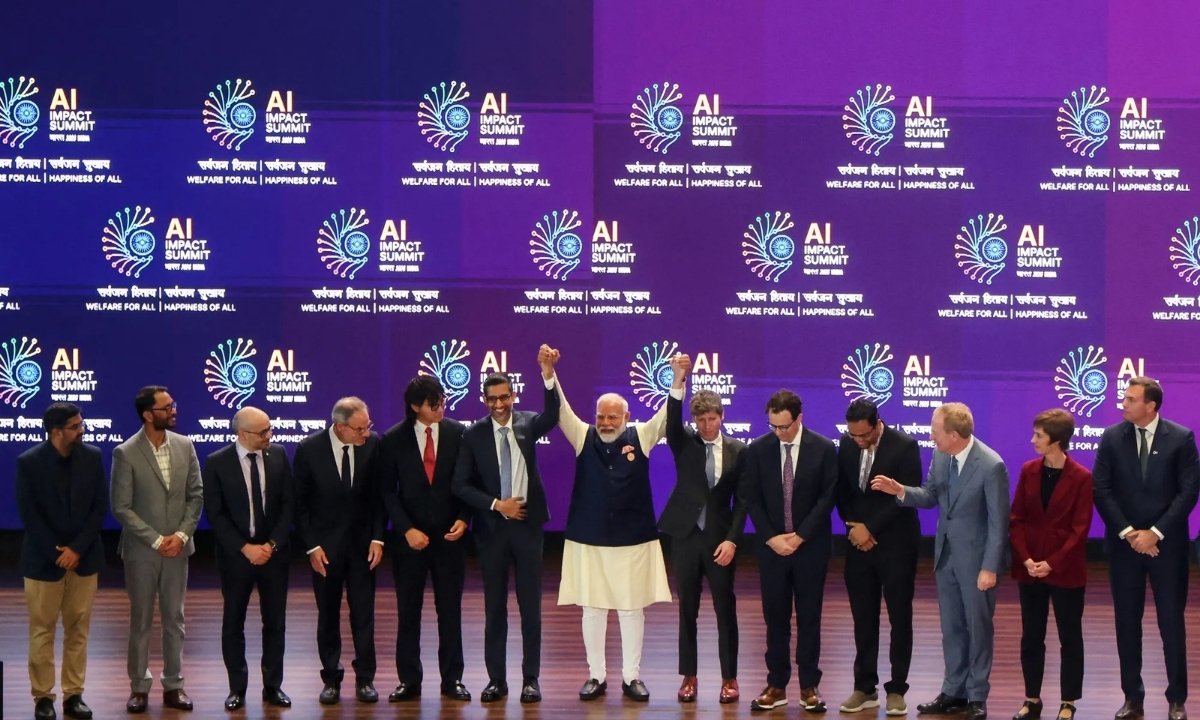
The AI Impact Summit 2026, held at Bharat Mandapam, emerged as one of the most consequential technology events ever hosted in India. Inaugurated by Prime Minister Narendra Modi, the summit brought together policymakers, global technology leaders, startups, researchers and students to shape conversations around the future of artificial intelligence.
More than a showcase of innovation, the summit positioned India as a central voice in global AI governance, responsible deployment and inclusive growth, particularly for the Global South.
PM Narendra Modi’s Vision for Human-Centric AI
In his inaugural address, Prime Minister Modi outlined a clear and values-driven approach to artificial intelligence. He emphasised that AI should enhance human capabilities rather than replace them, warning that unchecked technological progress could deepen inequality if ethics and accountability are ignored.
Modi reiterated India’s commitment to democratising AI by making advanced technologies accessible, affordable and inclusive. He highlighted that India’s scale, diversity and digital public infrastructure place it in a unique position to build AI systems that work for people across languages, cultures and income levels.
A major announcement during the summit was the MANAV framework for AI governance, focusing on moral and ethical systems, accountability, national data sovereignty, accessibility, inclusion and the development of valid and trustworthy technology.
Unprecedented Scale: Startups, Footfall and Global Participation
The India AI Impact Expo, which ran alongside the summit, featured more than 600 startups showcasing AI driven solutions across healthcare, education, fintech, climate technology, agriculture and governance. These innovations reflected India’s strength in applied AI built for real world, population scale challenges.
The summit recorded registrations exceeding three lakh participants, with more than five lakh visitors attending the exhibition over multiple days. Due to overwhelming demand, organisers temporarily paused new registrations and extended the expo by an additional day.
Delegations from over 30 countries participated in the event, underscoring its global relevance. Policymakers, investors and technology leaders engaged in discussions on AI governance, cross border collaboration and shared standards for responsible deployment.
Focus on Practical AI Applications Across Sectors
A key theme throughout the summit was the shift from experimental AI to real world deployment. Exhibitions and sessions highlighted AI tools designed for direct impact across critical sectors.
In healthcare, experts discussed how AI powered diagnostics, predictive analytics and clinical decision support systems could improve outcomes while extending services to underserved regions. Speakers consistently stressed that AI is intended to assist clinicians rather than replace them.
Industrial automation, robotics, multilingual conversational systems and accessibility focused technologies also featured prominently. These demonstrations reinforced the idea that AI’s value lies in solving everyday problems at scale rather than simply advancing technical benchmarks.
Sovereign AI and Sarvam Kaze Take Centre Stage
One of the most widely discussed showcases at the summit came from Bengaluru based Sarvam AI, which presented its indigenous large language models trained on Indian datasets and optimised for multiple Indian languages.
Prime Minister Modi visited the Sarvam pavilion and interacted with Sarvam Kaze, an AI powered conversational system designed to understand Indian languages with cultural and contextual awareness. The demonstration highlighted how homegrown AI models can address India’s linguistic diversity and accessibility needs more effectively than imported solutions.
Sarvam AI positioned itself as part of India’s broader sovereign AI movement, aligning closely with government efforts to build domestic capabilities across data, models and compute infrastructure.
Policy Dialogue, Investment Announcements and Infrastructure Push
Government leaders and industry executives used the summit to outline India’s long term AI strategy. Officials announced plans to significantly expand national GPU capacity, including the allocation of 20,000 additional GPUs for startups and researchers to ease compute bottlenecks.
Major corporations reaffirmed large scale investments in AI infrastructure, data centres and research. Overall, infrastructure commitments announced during the summit exceeded 250 billion dollars, with over 20 billion dollars in venture capital and deep technology investment pledges.
These announcements signalled growing confidence in India’s AI ecosystem and its ability to support innovation across the entire technology stack.
Responsible AI Pledges and Global Declaration
Ethical AI emerged as a defining pillar of the summit. In a landmark initiative, more than 2.5 lakh responsible AI pledges were collected within 24 hours, earning India a Guinness World Record. The campaign focused on transparency, accountability and safe AI usage.
The summit concluded with over 80 countries signing the India AI Impact Summit Declaration. The declaration emphasised responsible AI development, international cooperation and inclusive growth, reinforcing India’s role as a bridge between developed economies and the Global South.
Controversies and Operational Challenges
Despite its success, the summit was not without challenges. On Day 1, heavy footfall led to long queues and entry delays, while some exhibitors reported WiFi and payment disruptions. Organisers addressed many of these issues in subsequent days through improved coordination and crowd management.
A major controversy involved Galgotias University, which displayed a robotic dog at its stall claiming it as an indigenous innovation. The robot was later identified as the commercially available Unitree Go2 manufactured in China. Following verification and public backlash, the university was asked to vacate its stall, raising important questions around transparency and credibility in technology exhibitions.
Additional attention was drawn when Bill Gates cancelled his keynote address shortly before it was scheduled, and when visible rivalries among global AI leaders sparked discussion during public appearances.
India’s Emergence as a Global AI Convenor
The AI Impact Summit 2026 marked a strategic shift in India’s global positioning. Rather than competing solely on model size or compute power, India presented itself as a moral and strategic leader advocating inclusive access, ethical deployment and shared responsibility in AI development.
By bringing together governments, global technology firms, startups, researchers and citizens at unprecedented scale, the summit demonstrated India’s ability to convene the world around artificial intelligence.
As global AI adoption accelerates, the frameworks, partnerships and commitments forged in New Delhi are expected to influence policy, innovation and governance well beyond India’s borders. The AI Impact Summit 2026 may ultimately be remembered as the moment India stepped decisively into the role of global AI leader.