


Verdict
At ₹6,999, the URBN 200W GaN Power Hub is not a a very cheap option. That price will be a sticking point for anyone who only needs to charge a phone or laptop, particularly when smaller GaN chargers can handle those jobs for considerably less. But this is a product whose value depends heavily on how you use it. If your charging requirements extend to multiple high-power devices and a collection of accessories, the convenience is substantial. The weight is its biggest drawback for travel, but once it is sitting on a desk, that becomes largely irrelevant. After a four-day trip, my conclusion is fairly straightforward: despite the high price, the URBN 200W GaN Power Hub extremely useful. For someone who craves the simplicity of one charger handling an entire ecosystem of devices, ₹6,999 is a premium worth considering. For me, it has already moved from a travel accessory to permanent office equipment.
The Good
- 200W output
- Six ports
- Excellent power distribution
The Bad
- Quite heavy
- High asking amount
-
Design
-
Functionality
The best charging accessory is often the one you stop thinking about. That was my experience with the URBN 200W GaN Power Hub. I carried it with me on a four-day trip to Delhi, initially treating it as a convenient way of reducing the number of chargers in my bag. By the end of the trip, it had become the only charger I needed. My laptop, two phones, Apple Watch and a handful of smaller accessories could all live off the same unit, without constantly swapping plugs or hunting for another power socket.
That convenience is the real proposition here. The 200W figure makes for a good headline, but it is the ability to consolidate an entire charging setup into one device that makes the Power Hub particularly compelling. After four days of using it this way, I am keeping it on my office desk as my daily driver.
Design

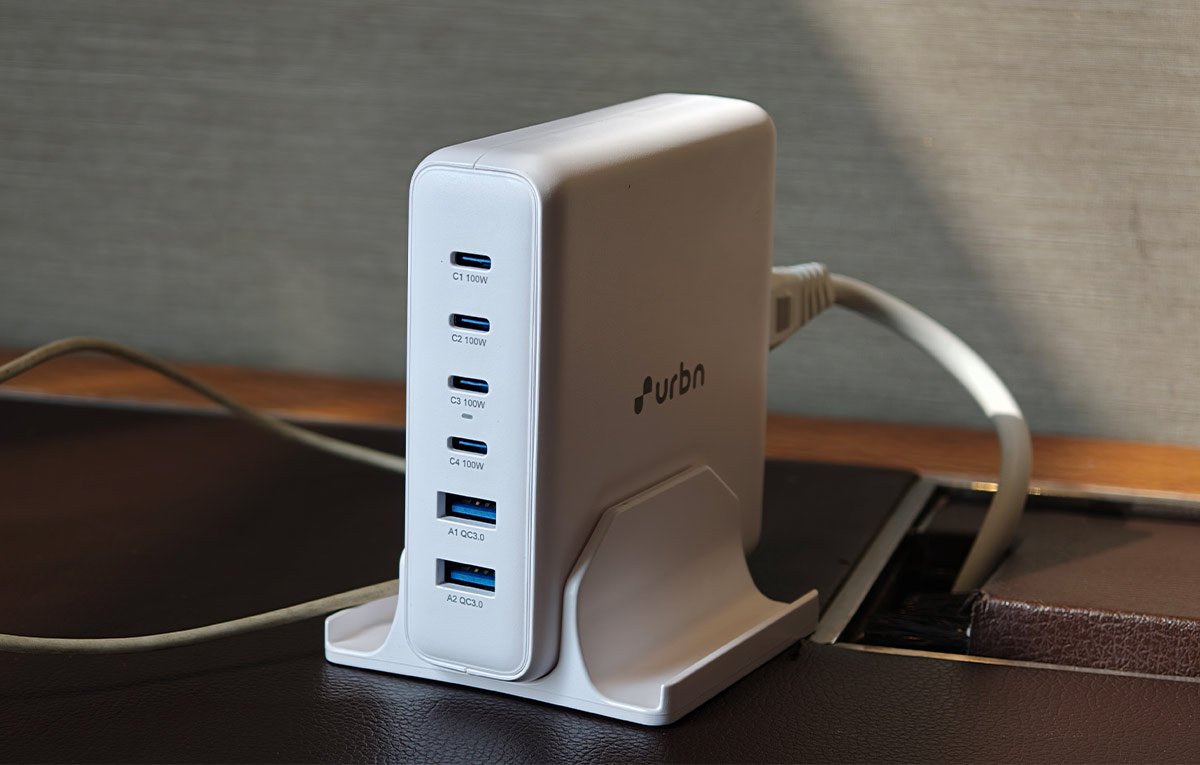
The Power Hub is unmistakably a desktop-oriented charger rather than something designed to disappear into a pocket. It has four USB-C ports and two USB-A ports, giving you six outputs in all. The USB-C ports support up to 100W each, while the USB-A ports can deliver up to 18W.
There is, however, one significant caveat if you intend to travel with it: this is a heavy piece of kit. At almost half a kilogram, the Power Hub adds noticeable weight to a backpack. That is considerably more than a conventional single-port GaN charger, and you feel it when you’re carrying a laptop and other equipment around all day.
The trade-off is that you are replacing several chargers with one. On my Delhi trip, that equation worked in its favour. Instead of carrying separate power bricks for my laptop and phones, I carried one relatively substantial unit and the required cables.
Functionality

This is where the Power Hub justifies its existence. Its four USB-C ports support USB Power Delivery and PPS, with each capable of up to 100W when used independently. More importantly, the charger has a sophisticated power-distribution system that reallocates its 200W capacity as more devices are connected. With two USB-C ports, for example, it can deliver 100W + 100W. With three USB-C ports, the distribution becomes 100W + 65W + 30W. With all six ports occupied, it delivers 65W + 45W + 45W + 20W + 10W + 10W.
In practical use, this matters more than the specification sheet suggests. At one point during the trip, I had two phones, my laptop and Apple Watch charging simultaneously, alongside other accessories at different points, and the Power Hub handled the arrangement without any fuss. There was no need to decide which device deserved the available charger or to carry a separate brick for lower-power accessories.

It also changed the way I think about my office setup. Six ports sounds excessive until you have a laptop, phone, secondary phone, smartwatch, earbuds and perhaps an SSD or another peripheral sitting around your desk. Suddenly, six ports feel quite sensible.