

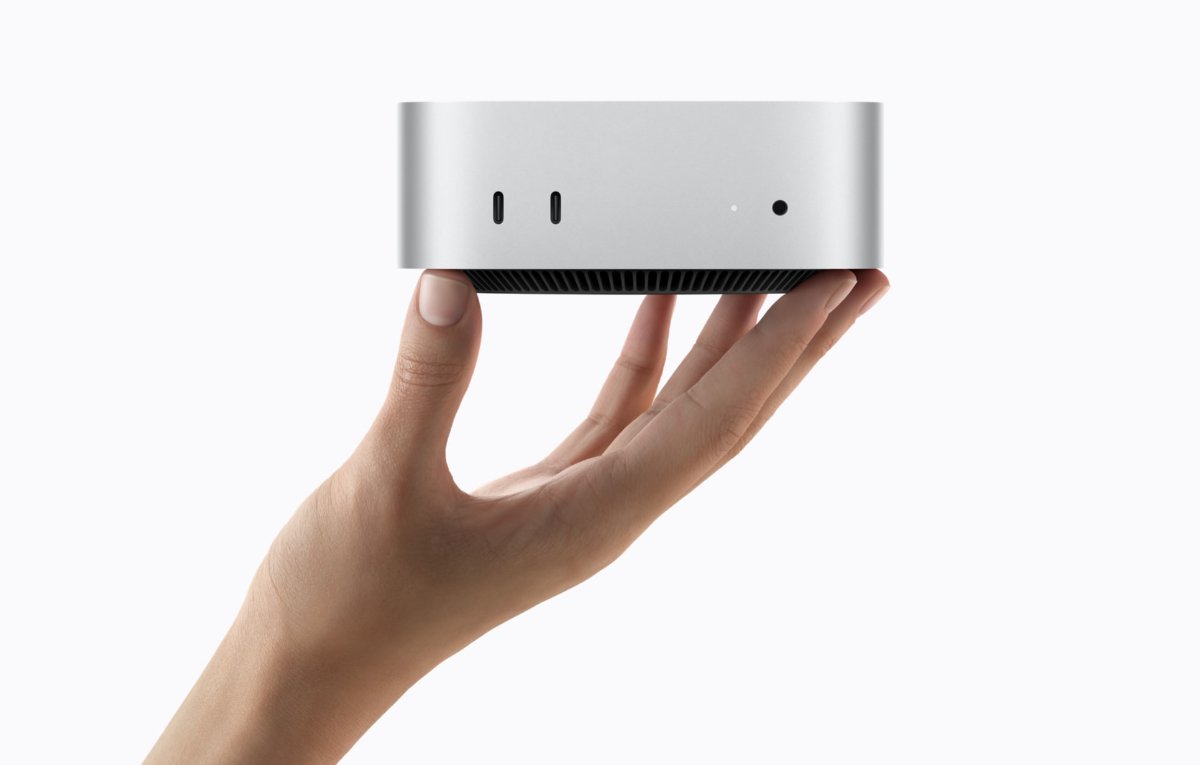
Apple’s long-awaited Mac Mini is here and is split into two chips: the all-new M6 for the standard model, and the M5 Pro. Pre-orders start today, and units ship September 22. With AI optimisation, on paper, the performance and price have both taken a step up. The numbers look aggressive, up to 4x faster AI performance, 2x faster graphics and storage, and 40% faster CPU work. This isn’t a spec bump for spreadsheets and photo edits, Apple frames it as “always-on agentic computing.”
The new baseline: Mac Mini M6
The base Mac Mini now runs on M6, which includes a 12-core CPU and a 12-core GPU, two more cores each than the M4. For the first time on a Mac Mini, every GPU core includes a Neural Accelerator, and Apple pairs that with a Dual 16-core Neural Engine. Together, these deliver the 4x AI performance claim and 2x faster graphics compared to M4.
The base configuration still ships with 16GB of unified memory, priced at ₹99900, configurable up to 32GB, with bandwidth rising to 170GB/s. That’s a bump from previous versions, but running serious local AI models needs memory more than raw computational ability. So even with faster Neural Accelerators, the base M6 Mini stays better suited to lighter on-device AI tasks rather than hosting large language models on its own.
Let’s look at a few of Apple’s own benchmarks: LM Studio prompt processing jumps up to 13.5x versus the M1 Mini, and 4.8x versus M4. Excel calculations improve 2.3x over the M1 and 1.5x over M4. The benchmark also claims up to 2x faster gaming performance with ray tracing in Cyberpunk 2077: Ultimate Edition when compared to Mac Mini with M4
The powerhouse: Mac Mini M5 Pro
The M5 Pro model is where Apple is pulling all its top hardware together. It scales up to an 18-core CPU and a 20-core GPU with third-generation ray tracing, and it supports up to 64GB of unified memory at 307GB/s bandwidth, nearly double the M6 model’s cap. That memory is what actually lets users run larger local AI models, handle ProRes RAW footage, or work with big 3D scenes without swapping to cloud compute.
Compared with the previous M2 Pro Mini, Apple claims up to 8.5x faster LLM prompt processing, 4.5x faster Blender rendering with ray tracing and 2.1x faster image processing in Affinity. Against the more recent M4 Pro, though, those shrink to 4x, 1.4x and 1.5x, respectively.
Both models get Wi-Fi 7, Bluetooth 6, and 2.5Gb Ethernet (10Gb optional), but only the M5 Pro gets three Thunderbolt 5 ports on the back, versus Thunderbolt 4 on the M6. Thunderbolt 5 also lets users cluster multiple Mac Minis together to run large AI models across machines.
Also Read: One Week with the Apple MacBook Neo
The Verdict
Apple released the Mac Mini alongside a refreshed Mac Studio (with M5 Max and M5 Ultra) on the same day. The company is building a tiered AI-computing lineup. The Mac Mini is the affordable, compact entry point into that lineup, while the Mac Studio is for users who need more memory or GPU muscle than even the M5 Pro Mini can offer.
In India, the M6 Mini now starts at ₹99,900 for 16GB of memory and a 256GB SSD. The M5 Pro starts at ₹2,09,900 for the base 15-core CPU/16-core GPU/24GB configuration, and climbs to ₹2,33,900 for the full 18-core CPU/20-core GPU tier. In the US, the base M6 Mini starts at $899, up from $799 after Apple already raised M4 pricing earlier this year, and $300 higher than the original $599 M4 launch price. That makes this the highest starting price a Mac Mini has ever been, while 256GB still ships as base storage in 2026.
For everyday buyers, the M6 Mini brings a real upgrade over the M4 in graphics and speed, plus better connectivity. For creative professionals and developers running local AI workloads, the M5 Pro’s memory bandwidth and ability to cluster make a stronger argument, but only once you move past the base 24GB configuration.