


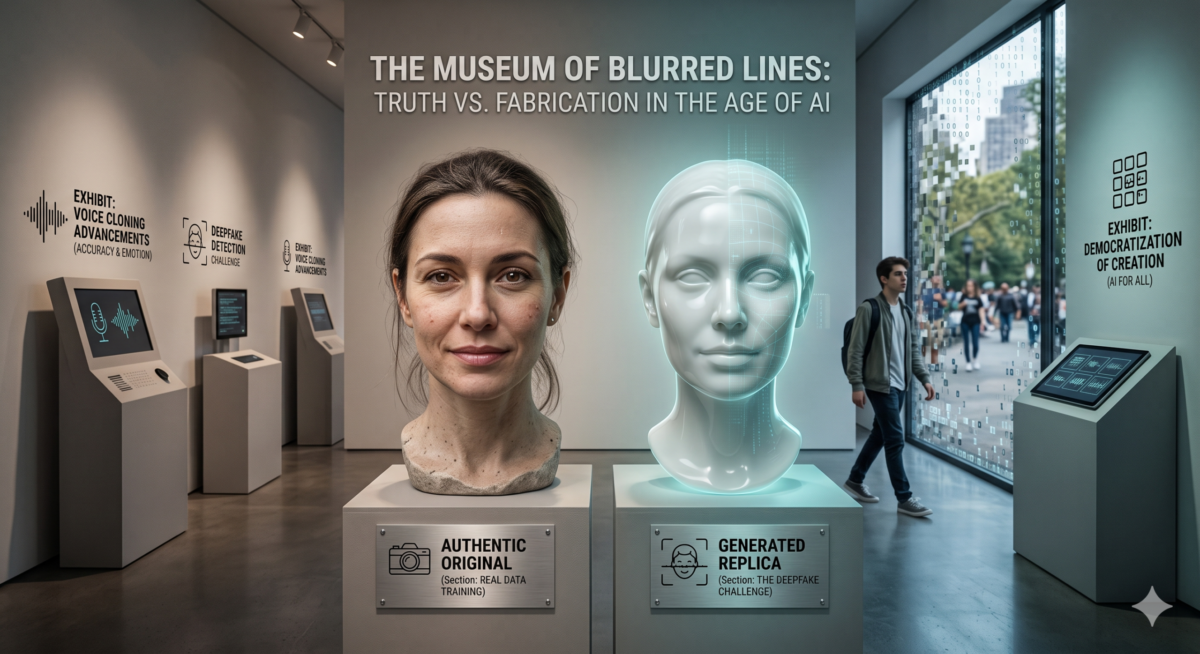
Artificial Intelligence has rapidly transformed the digital content landscape, making AI-generated images and videos more realistic than ever before.The ability to use artificial intelligence to generate video and image content has gotten so realistic that it can be hard for users of social media and marketing strategies to tell what is real and what was generated by artificial intelligence. On top of that, the advancement in generative artificial intelligence has led to an almost non-existent line between what is real (truthful) versus what has been fabricated (false) as a result of this technology’s fast development and growth.
Artificial Intelligence (AI) becomes smarter by examining vast amounts of existing data in reality (Real-Time Data).
“There are two main factors to the decrease in the distinction between true content vs AI-created content. First, AI-generated visuals are being trained on a lot of actual data from the real world and all the different associated types of data that exist today (i.e., pictures, videos, facial expressions/voice samples, and human interaction data). Because of all this data, AI models can now analyze and learn about all of the aspects humans make judgment upon, such as lighting, skin texture, motion, shadows, human emotions, and speech accurately. As such, artificial-intelligence-created visual images can now be virtually indistinguishable from images taken by conventional cameras – thus allowing AI to create photorealistic images in a matter of minutes.” says Aksheshkumar Ajaykumar Shah.
AI Models Can Now Replicate Human Movement and Expressions More Accurately.
“As a result of the rapidly advancing capabilities of generative artificial intelligence, there are now substantially more sophisticated models that assist in replicating the way humans display their emotions and communicate as part of our daily lives. For example, eye movement, facial expressions, lip movement while speaking, and body language have all been mastered by these systems, especially in the generation of deepfake videos, and make human detection of manipulated images or videos similarly far more challenging than they could previously. Voice cloning technologies have progressed to such an extent that they can produce a person’s voice with exceptional accuracy, right down to the individual’s tone, accent, cadence, and expression of emotion.” adds Aksheshkumar Ajaykumar Shah.
AI Tools Are Becoming Accessible to Everyone
“AI is an emerging technology that is democratizing the power of generating realistic content. This growth comes from the increased availability of tools that allow the average person to create high-quality images, videos and clone voices using just a few lines of text. The accessibility of AI tools to everyone has spurred innovation as well as abuse. As machine learning continues to advance through learning from historical mistakes, it will continue to remove visual flaws in previously generated AI content. Each new release of AI systems is built on the failures of the last, resulting in a significant decrease in distortion, unrealistic rendered images and inconsistencies. When combined with cost-effective and high-quality editing systems used to produce movies, the majority of today’s AI generated content has the appearance of being refined and cinematic. Consequently, this has created a real difficulty in distinguishing what is real from what is not.

Social media also contributes to this challenge in that compression algorithms used by these platforms degrade quality of video and images (e.g., blurring and compression). Even when subtle visual flaws occur due to the effects of AI manipulation, most consumers of images/video will not have the propensity to verify the source or authenticity of the content before sharing it. As such, misleading visuals that are generated by AI can often be shared widely before they can be fact-checked by credible sources.” says Prerak Manish Shah, Co-founder and Technology Lead in Data Infrastructure & AI, Cogniify.ai.
Is It Possible to Detect AI Generated Content?
Detecting AI-generated content may be more difficult than ever, but it is not entirely impossible. Researchers and cybersecurity professionals are currently designing systems that will allow AI detection techniques, as well as ways to watermark AI-generated materials, in order to identify altered media. Unfortunately, the pace at which generative AI advances will make it difficult to keep pace with developing methods of detecting the generated media” adds Prerak Manish Shah, Co-founder and Technology Lead in Data Infrastructure & AI, Cogniify.ai.
The Importance of Digital Literacy
The advancements of AI may place us in a time where there is no longer a valid way to trust that we can believe that we can see. It is thus increasingly important that we have a strong sense of digital literacy, as well as responsible AI regulations and publicly educated about these new technologies.