



In an era where technology relentlessly shrinks while capabilities explode, portable storage has undergone a remarkable transformation. Gone are the days of bulky external hard drives and oversized USB sticks that dominate your bag or protrude awkwardly from devices. Today’s flash drives pack terabytes into fingernail-sized bodies, leveraging advanced NAND flash and efficient controllers. The SanDisk Extreme Fit USB-C (512GB variant) exemplifies this trend, a tiny plug-and-stay drive designed for seamless integration with modern USB-C devices. We tested the 512GB model extensively during a recent trip to Vietnam, directly transferring images and videos from a smartphone on the go. Is this the ultimate compact drive for travellers, creators, and everyday users? Let’s find out.
BUILD & DESIGN
The SanDisk Extreme Fit lives up to its name in every sense. Measuring roughly 18.5 x 15.7 x 13.6 mm and weighing a mere 3 grams, it is extraordinarily compact. It is so small that once plugged into a laptop’s USB-C port, it blends in almost invisibly. There is no awkward protrusion that could risk damage or snag on anything in your bag. On slimmer laptops or tablets, it sits flush or nearly so, allowing you to close lids or slide devices into sleeves without issue. This “plug-and-stay” design makes it ideal for permanent storage expansion on devices like MacBooks, Windows laptops, or iPads.
The build quality feels solid despite the miniature size. It has a matte plastic exterior that resists fingerprints and minor scratches. I also have the SanDisk logo on the front. The USB-C connector is sturdy enough for repeated insertions. During my Vietnam trip, which included humid conditions in Phu Quoc and transfers to Starfish Beach, it handled everyday travel abuse without issue. No rubberised protection or IP rating is available here, unlike some rugged SanDisk models, but the minimalist design prioritizes discretion over toughness.
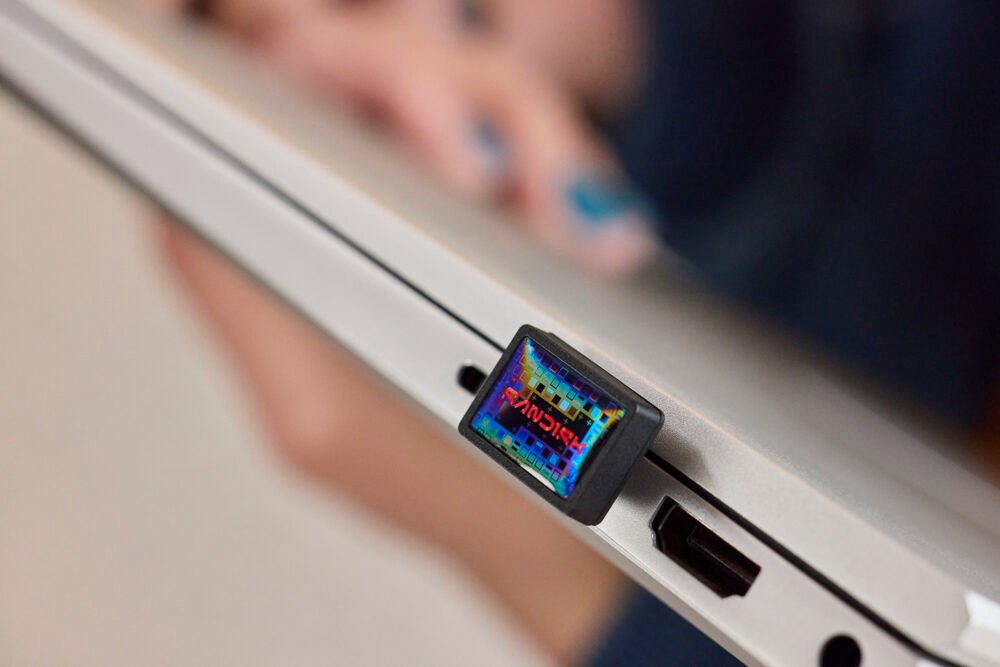
One notable drawback of its tiny footprint: it is incredibly easy to misplace. We nearly lost it once when it detached during a hurried pack-up. Overall, fitting 512GB of high-speed storage into such a tiny package is a marvel of engineering. It redefines convenience for users who want extra storage without carrying extra bulk.
PERFORMANCE
Don’t let the miniature size fool you; the SanDisk Extreme Fit delivers respectable performance that punches above its weight for a thumb drive. Officially rated for USB 3.2 Gen 1 with read speeds up to 400MB/s (for 128GB–1TB models), it excels at quick file access and transfers.
In our real-world testing on the Vietnam trip, we transferred hundreds of images and 4K videos directly from a smartphone to the drive. For smaller batches (under 5GB), it felt snappy, and large photo bursts copied efficiently without much wait. Read performance consistently approached the advertised 380–390 MB/s in benchmarks, making it great for viewing media directly from the drive or for pulling files quickly on a laptop.
Write speeds are more subtle. For moderate transfers, we observed initial average rates of 130–170 MB/s. However, as transfers grew larger (tens of GB during backlog dumps of trip footage), speeds tapered off to around 80–100MB/s. This is typical of flash drives due to their limited cache, but it still outperformed many older USB sticks. In CrystalDiskMark-style tests, sequential reads hit near 400MB/s, with writes in the 170MB/s range for shorter bursts.
Heat management stayed reasonable; the drive warmed up during sustained writes but never throttled dramatically or became uncomfortable. Compatibility proved broad and seamless across Android smartphones, Windows laptops, and iPadOS for direct backups.
For on-the-go creators or travellers like us, it handled the workflow beautifully: shoot on the phone, transfer to the drive for backup, and free up space instantly. It is not a replacement for a full external SSD in heavy video editing, but it shines for quick offloads and portable archiving.
VERDICT
The SanDisk Extreme Fit 512GB is a highly recommended ultra-portable storage solution, featuring a compact design, solid 400MB/s read speeds, and reliable performance for images and videos, making it ideal for travelers, students, and professionals. Its advantages include broad compatibility and sufficient speed for everyday transfers, though it has minor drawbacks like slower write speeds on large files, a risk of loss due to its small size, and no rugged sealing. Overall, it offers excellent value at its price point and is perfect for discreet, high-capacity storage for light-to-moderate use.