


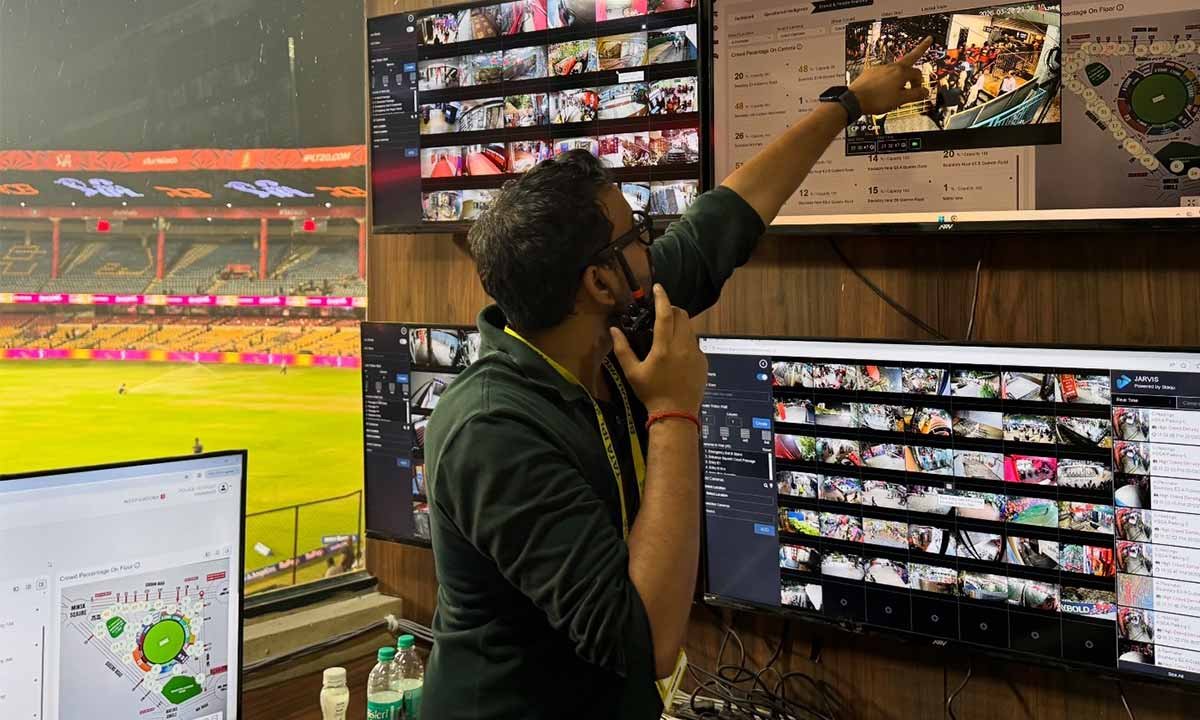
Bengaluru’s M. Chinnaswamy Stadium, one of India’s most iconic cricket venues, has introduced an AI-powered surveillance system called JARVIS to strengthen crowd management and security during high-attendance matches.
Developed by Staqu Technologies in partnership with Royal Challengers Bengaluru (RCB) and the Karnataka State Cricket Association (KSCA), the system operates across a network of more than 500 CCTV cameras installed throughout the stadium.
The AI command platform is designed to monitor large crowds in real time, particularly during high-profile matches that attract over 40,000 spectators. Cameras placed across entry and exit gates, concourses, seating areas, food courts and movement corridors feed into three dedicated video walls within the stadium’s control rooms.
These displays allow operators to switch between multiple surveillance feeds instantly and monitor crowd movement across different zones simultaneously.
Also Read: Str8bat Review: A Cricketer’s Comeback with a Twist of Tech
One of the system’s most notable applications was seen during recent RCB matches, where authorities identified and recovered 21 stolen mobile phones worth ₹18 lakh from a gang of 11 thieves.
Using JARVIS’s reverse facial recognition capability, investigators uploaded suspect images into the system, which then scanned CCTV feeds to track individuals across the stadium. The technology enabled authorities to trace movement patterns, flag suspicious behaviour and coordinate with on-ground police teams to intercept suspects in a timely manner.
Beyond theft prevention, the platform also focuses on proactive crowd management. Its Spatial AI mapping engine overlays CCTV feeds onto a digital map of the stadium, giving security teams a clear overview of activity across multiple locations. Meanwhile, the system’s crowd density intelligence continuously estimates the number of people in each zone and identifies congestion risks before they escalate.
According to Staqu Technologies Founder and CEO Atul Rai, the technology is designed to distinguish between normal crowd movement and potential risks. “A marathon can visually resemble a stampede, but the density and formation context tell a completely different story,” he said.
By reducing the need for constant manual monitoring, JARVIS allows security teams to focus on response and coordination, helping create a safer environment for spectators during large sporting events.