


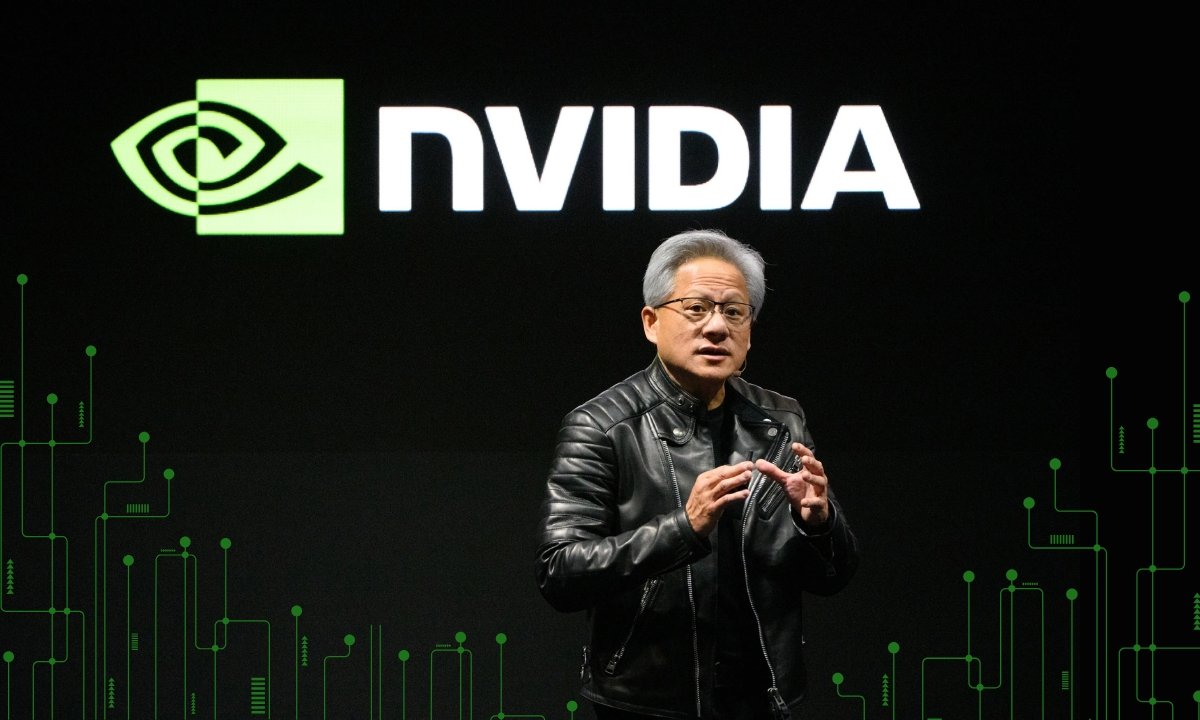
Most people discovered Jensen Huang when NVIDIA became the poster child of the AI boom. The leather jacket, the giant keynote stages, the trillion-dollar numbers and the now-famous “AI factory” vocabulary made him one of technology’s most recognisable CEOs. But the real Jensen Huang story started much earlier, when NVIDIA was a relatively tiny graphics-chip company fighting for survival.
Huang co-founded NVIDIA in 1993 with Chris Malachowsky and Curtis Priem. The original idea was not AI, autonomous cars or humanoid robots. It was 3D graphics for PCs and gaming. NVIDIA invented the GPU in 1999, but what matters in hindsight is what Huang did next. He kept asking a slightly dangerous question: what else can this technology do? NVIDIA’s own timeline shows the progression clearly – GPU in 1999, CUDA in 2006, the AlexNet AI breakthrough in 2012, RTX in 2018 and Omniverse later on. CUDA was arguably the biggest strategic bet of them all. NVIDIA didn’t just want developers to buy its chips. It wanted them to build software around NVIDIA’s architecture. That distinction is enormous. A faster chip can eventually be beaten. An entire developer ecosystem is much harder to dislodge. Huang has described the resulting “virtuous cycle” himself: more CUDA applications make CUDA more valuable, which encourages more people to buy CUDA-enabled computers, which attracts more developers. After decades of investment, that flywheel became one of NVIDIA’s strongest competitive advantages.
Then came the moment that changed everything. In 2012, researchers used NVIDIA GPUs to power AlexNet, the neural network that dramatically demonstrated the potential of deep learning. Suddenly, the technology NVIDIA had been nurturing for years had found a new job. The company wasn’t merely making graphics processors anymore. It was sitting on the computing architecture that AI desperately needed.
Watch the YouTube Shorts: NVIDIA Started 10 Years Earlier Than Others
This is where Huang’s leadership gets particularly interesting. He doesn’t seem obsessed with protecting NVIDIA’s existing business. He is almost obsessed with making the existing business obsolete before somebody else does it. In an interview with WIRED, Huang described NVIDIA as a company that has reinvented itself several times – from a chip company to a systems company and then to an infrastructure company.
That philosophy explains why NVIDIA today looks very different from the NVIDIA of 20 years ago. It now sells an entire computing stack – chips, networking, systems, software and platforms. At CES 2026, Huang was already talking beyond generative AI towards physical AI, robotics, autonomous vehicles and industrial simulation. NVIDIA’s Vera Rubin platform is designed around an increasingly complete AI infrastructure stack rather than simply another GPU.
And the numbers show just how large that transformation has become. NVIDIA’s fiscal 2026 revenue reached $215.9 billion, with full-year data-centre revenue at $193.7 billion, up 68%. Its fourth-quarter data-centre revenue alone hit $62.3 billion. The company is now moving into something even more ambitious: treating AI compute itself as infrastructure. NVIDIA announced partnerships with major financial institutions including BlackRock, Apollo, Blackstone, Brookfield, Goldman Sachs and KKR aimed at mobilising more than $500 billion of third-party capital for AI infrastructure over time.
Also Read: Jeff Bezos – The Billion Dollar Habit of Making Decisions Before You’re Ready
That is the fascinating part. Huang isn’t simply selling the shovels in the AI gold rush anymore. He increasingly wants to help build, finance and define the gold mine.
But there is another lesson hidden in the story. NVIDIA’s rise wasn’t a straight line. The company made wrong bets, changed architectures and repeatedly entered markets before there was obvious demand. Huang himself has acknowledged that NVIDIA had to admit when its technology was fundamentally wrong and change direction.
That may be the most “Indisciplined” part of Jensen Huang. Discipline is usually associated with staying on course. Huang’s version is different. Stay obsessed with the destination, but be completely willing to change the vehicle.
And perhaps that is why he has survived 33 years as NVIDIA’s CEO. He isn’t defending a business model. He is defending a mission to remain relevant to the next version of computing.
The Key Takeaway
Jensen Huang’s greatest bet wasn’t the GPU. It was the belief that computing itself was going to change, and NVIDIA needed to be ready before everyone else realised it.
He didn’t wait for AI to become a trillion-dollar industry. He spent decades building the infrastructure that would make that industry possible.
The Indisciplined Playbook
- Build for the market that doesn’t exist yet.
CUDA looked like an expensive side bet when NVIDIA launched it. Today it is central to NVIDIA’s software moat. - Don’t fall in love with your current business.
Gaming built NVIDIA. AI transformed it. Huang keeps moving before the old story becomes the company’s ceiling. - Create ecosystems, not products.
Hardware gets replaced. Developers, software and infrastructure create much stickier relationships. - Be comfortable being early.
The biggest advantage sometimes comes from spending years preparing for a trend that everybody else thinks is too far away. - Change the vehicle, not the destination.
NVIDIA has moved from graphics to accelerated computing to AI infrastructure. The underlying ambition stayed remarkably consistent. - Think in decades.
The GPU was introduced in 1999. CUDA arrived in 2006. AlexNet happened in 2012. The AI explosion came much later. The payoff was years in the making. - Don’t confuse discipline with staying still.
Sometimes the most disciplined thing a leader can do is admit the original plan was wrong and rebuild it.
Jensen Huang didn’t predict every turn of the technology industry. He did something more useful. He built NVIDIA so that when the next turn arrived, the company was already sitting at the corner.
1 Comment
Pingback: NVIDIA RTX Spark PCs Launch With Up to 128GB