


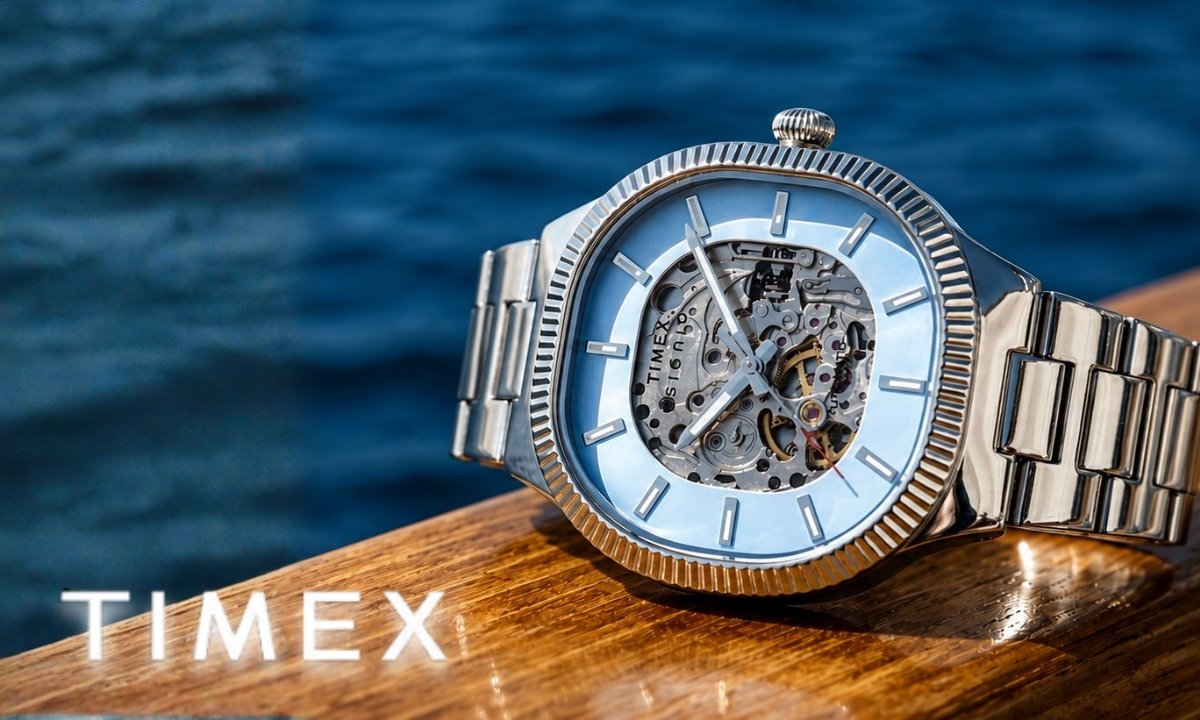
What do you do when you have been making watches for 172 years and suddenly everyone has a phone that tells the time better than you ever could?
You start giving people a reason to want to wear a watch.
That, in many ways, is the Timex story. The company started in 1854 as the Waterbury Clock Company in Connecticut, USA, at a time when owning a reliable watch wasn’t quite the everyday habit it is today. From the beginning, Timex built its reputation around watches that were reliable, practical and affordable. But what makes the brand interesting isn’t just how long it has been around. It is how well it has understood the art of making a relatively simple product feel relevant again and again.
And there is another interesting twist in the Timex story. The brand may feel like an old-school American watch company, but the group behind it today is backed by The Baupost Group, the Boston-based investment firm founded by Seth Klarman. In 2020, an affiliate of Baupost acquired majority ownership of Timex Group, while existing shareholders retained a significant stake. Timex Group is now a privately held global watch business with a portfolio that includes the Timex brand as well as licensed and owned businesses across fashion and luxury watch categories.
For our Indian audience, there is an interesting comparison here. HMT was already making watches in India from the 1960s, with its first watch factory opening in Bengaluru in 1962 and quartz analogue watches arriving in 1981. HMT became an important part of India’s watch story and, for generations, owning an HMT watch was almost a rite of passage. Timex came to India much later. The Indian company was incorporated in 1988 as a joint venture with Jayna Times Industries, which withdrew from the project in 1990 and was replaced by Titan Watches. By 1991, the company had become Timex Watches Limited and had a Noida plant with capacity for 2.5 million quartz watches a year.
Watch the YouTube Shorts: How Timex Survived 172 Years While HMT Fell Behind
That difference is worth noticing. HMT had the heritage, the manufacturing story and a huge place in India’s watch history. Timex came in with a different proposition: product, technology, marketing and accessibility. And over time, Timex became particularly good at taking a simple feature and turning it into something consumers could remember.
One of the best examples is INDIGLO. Today, a watch lighting up at night doesn’t sound particularly revolutionary. In the early 1990s, it was a genuinely useful bit of technology. Timex had been experimenting with electroluminescent technology and used it to create a thin light-producing layer underneath the dial. Press the button and the entire face glowed, making the time easy to read in the dark. Timex says INDIGLO was introduced in 1993, while its history records digital and analogue watches with the feature being released in 1992.
But here’s where Timex deserves real credit from a product-marketing point of view. Timex didn’t invent electroluminescence. It took the technology, solved a very simple consumer problem and then gave it a name. INDIGLO wasn’t buried somewhere at the bottom of a specification sheet. It became part of the Timex experience. Instead of telling someone that a watch had an electroluminescent backlight, Timex could simply say it had INDIGLO. Suddenly, a small piece of engineering had become a piece of brand equity. Genius, really.
That is something I feel Timex has been remarkably good at. The Ironman turned a watch into a piece of sports equipment. The Q Timex took a design from the quartz era and made it desirable again. The Marlin brought back the character of Timex’s mechanical-watch history. Expedition gave the brand an outdoor personality. And now Timex still mixes its archive with collaborations, contemporary design, and new materials. In fact, in July 2026, Timex Group completed its acquisition of Daniel Wellington, after initially taking a 25% stake in the brand three years earlier. It is another sign that Timex isn’t sitting around admiring its own history.
Also Read: Toyota – The Company That Walked Away From Success
The smartphone should have been a nightmare for watch companies. Suddenly, everyone had a clock in their pocket. But Timex didn’t try to compete with the phone at telling time. It changed the reason for owning the watch. It became about design, personality, nostalgia, fashion, functionality and, sometimes, simply wanting something on your wrist that wasn’t another glowing rectangle.
And this is where the Timex versus HMT story becomes interesting. Both have enormous heritage, but Timex has been particularly aggressive about repackaging its heritage for new consumers. It doesn’t seem embarrassed by its past, but it also doesn’t expect the past to sell the product by itself. That’s a very important distinction.
The numbers in India suggest the strategy is working. Timex Group India reported FY2025-26 revenue of ₹800 crore, up 48% year on year. EBITDA jumped from ₹49.7 crore to ₹116 crore, while profit before tax rose 151% to ₹107.4 crore. The core Timex brand itself grew 62%, while e-commerce grew 90%. The company says revenue has grown from ₹265 crore in FY22 to ₹800 crore in FY26, a threefold increase in four years.
And that is why Timex belongs in the Indisciplined Leader list. It didn’t survive 172 years simply by protecting its heritage. It kept finding new ways to package it, new features to talk about and new reasons for people to care.
The smartest thing Timex may have understood is that people don’t always buy products because they need them. They buy them because the product gives them a reason to want it.
INDIGLO is a perfect example. It wasn’t just a light. Timex turned it into a name, a feature and eventually a piece of the brand itself.
That is product marketing done right.
Key Takeaway
Longevity isn’t about refusing to change. It is about knowing what to change before the world changes you.
The Indisciplined Playbook
- Turn features into reasons to buy. INDIGLO was technology, but Timex made it part of the product’s identity.
- Name what makes you different. A named feature is easier to remember than another line in a specification sheet.
- Don’t expect heritage to do all the work. HMT and Timex both show the power of heritage, but Timex has been particularly aggressive in giving its heritage new forms and new audiences.
- Make the product desirable, not just useful. When the smartphone made watches less necessary, Timex found other reasons for people to wear one.
- Keep reinventing the reason to buy. The product may still tell time, but the reason people buy it in 2026 is very different from why they bought one in 1950.
1 Comment
Pingback: The Indian Watch Brand That Lost Time, But Never Lost It's Story