

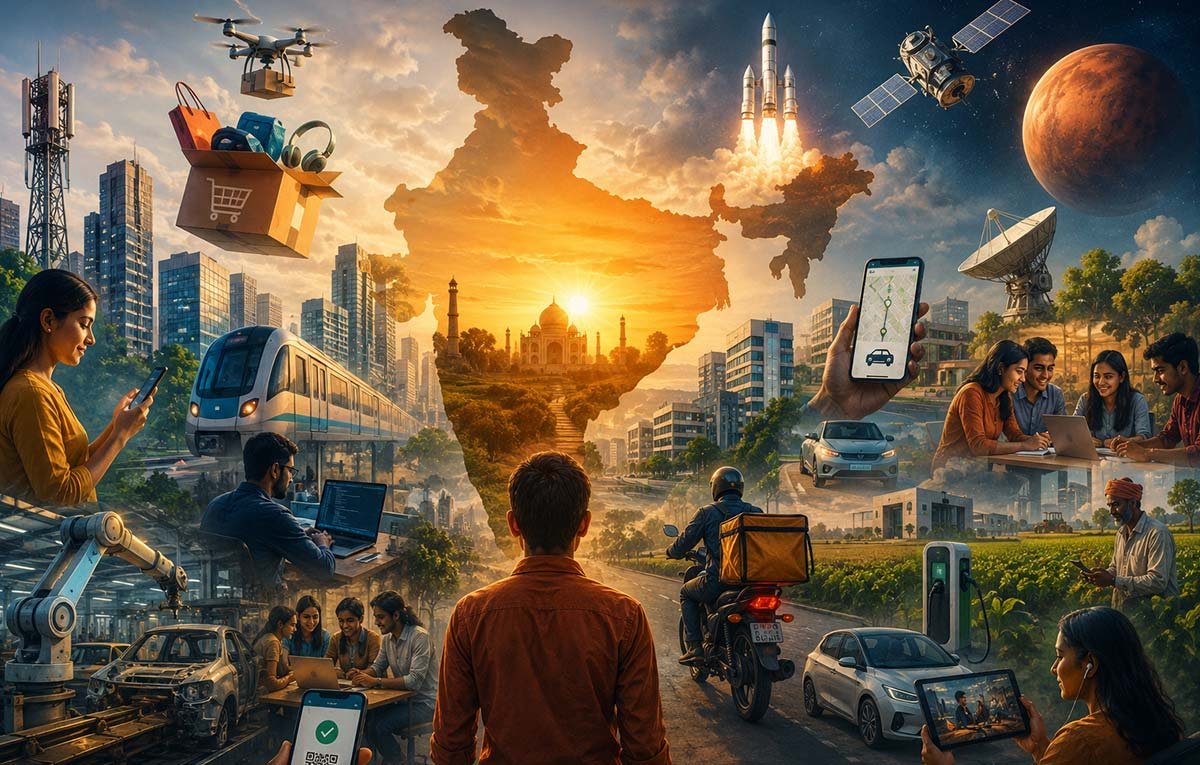
India’s independence story is often told through its great political moments. Yet nations are shaped just as profoundly by the ideas that enter everyday life. The way we make a phone call, hail a cab, pay for dinner, watch a film, build a company or travel across a city can reveal as much about a country’s transformation as any economic statistic.
The India of 1991 was a very different proposition. The economy was opening up, technology was beginning to find its place, and a new generation was growing up with aspirations shaped by a rapidly changing world. Over the next three decades, that change accelerated. Computers became careers, mobile phones became necessities, the internet became infrastructure and entrepreneurship became an ambition for millions.
Some of these ideas came from government policy. Others emerged from Indian companies, global technologies, scientific institutions or young entrepreneurs who saw opportunities where previous generations had seen limitations. Together, they altered the country’s economic landscape and, in many cases, its social fabric.
This is not a ranking. It is a chronicle of twenty defining shifts since 1991, arranged broadly in the order in which they entered India’s consciousness. Some created entirely new industries. Others transformed existing ones. A few changed something even more fundamental: what Indians believed was possible.
As the country approaches 80 years of Independence, these are twenty ideas that helped shape the India we know today.
Economic Liberalisation – Opening the doors
The reforms of 1991 changed India’s economic direction. Faced with a severe balance of payments crisis, the government led by P V Narasimha Rao and Finance Minister Manmohan Singh dismantled much of the Licence Raj, reduced import barriers and opened the economy to foreign investment.
For Indians who grew up in the 1990s, liberalisation became visible in surprisingly ordinary ways. International brands appeared in Indian stores. Cable television brought a wider world into living rooms. Fast food chains, foreign cars, consumer electronics and new fashion labels altered what people aspired to own.
The transformation extended far beyond consumption. Competition increased, private enterprise expanded, and Indian companies gained access to global markets. The reforms helped create the conditions for the IT boom, the rise of the modern middle class and the entrepreneurial economy that followed.
Modern India’s economic story begins here.
IT Services Revolution – India finds its code
India’s greatest export of the 1990s was not a physical product. It was expertise.
Companies such as TCS, Infosys, Wipro and HCL built a global technology services industry by combining India’s vast pool of engineering talent with an increasingly connected world. The Y2K problem provided an enormous opportunity, as businesses worldwide turned to Indian programmers to modernise legacy systems before the millennium.
The success proved that Indian talent could compete globally without leaving India. Bengaluru, Hyderabad, Pune, Chennai and Gurugram became technology centres, attracting investment and creating a new class of well paid professionals.
The industry’s influence spread into education, real estate, travel, consumer technology and finance. It changed the ambitions of middle class families and made engineering and computer science among India’s most coveted career paths.
More importantly, IT services gave India a new identity on the world stage. The country was no longer simply a market. It was becoming a technology partner.
Mobile Phones for the Masses – The call goes everywhere
India’s first mobile call was made in 1995, but mobile phones remained expensive for years. The real revolution came in the 2000s, when cheaper handsets, expanding networks and fierce competition among telecom operators made mobile connectivity accessible to millions.
The change was fundamental. A telephone was no longer attached to a house, office or public booth. It travelled with its owner.
For small businesses, farmers, traders and independent workers, the mobile phone became an essential economic tool. Families separated by migration could stay connected. Missed calls developed their own language. Prepaid recharge became part of everyday life.
The mobile phone also laid the foundation for India’s digital future. Before smartphones, apps and digital payments could become ubiquitous, India first needed to become a country where hundreds of millions of people had access to a personal telephone.
The mobile phone did precisely that, turning communication from a fixed service into a personal utility.
Metro Rail Networks – Cities learn to move
Kolkata introduced India’s first metro in 1984, but the modern metro era began with the Delhi Metro in 2002. Its punctuality, cleanliness and operational discipline demonstrated what urban public transport could look like in a rapidly growing Indian city.
The success of Delhi Metro became a template for other cities. Bengaluru, Mumbai, Hyderabad, Chennai, Kochi, Ahmedabad, Nagpur and Pune followed, with networks expanding as urban populations and traffic congestion grew.
The impact goes beyond shorter commutes. Metro stations have become anchors for commercial and residential development, while millions of commuters have gained an alternative to private vehicles and increasingly unreliable road journeys.
The metro has also changed the psychology of urban travel. A predictable journey can alter where people choose to live, work and study. For growing cities, it represents a long term investment in mobility and urban planning.
India’s metro network is still expanding, but its significance is already clear. The modern Indian city is increasingly being built around its rail network.
E-commerce – The shop without walls
Indian retail was once defined by geography. What you could buy depended heavily on where you lived and what local stores stocked. E-commerce dismantled that limitation.
Flipkart’s arrival in 2007 helped introduce online shopping to a mass Indian audience. Cash on delivery, improved logistics, easier returns and growing trust gradually turned a novelty into a habit. Amazon’s subsequent expansion accelerated the transformation.
For consumers, the biggest change was choice. Someone in a smaller city could access products previously available only in major urban centres. For entrepreneurs and small businesses, the internet offered access to customers across the country without the expense of a physical retail network.
E-commerce also created an enormous logistics ecosystem, from warehouses and delivery fleets to sophisticated supply chain technology. Traditional retailers were forced to embrace digital channels, while newer models such as quick commerce emerged from the same infrastructure.
The Indian marketplace became dramatically larger, faster and more accessible. The neighbourhood shop remained important, but the internet created an aisle with no end.
Smartphones – The computer in your pocket
India had already embraced mobile phones when smartphones arrived, but the smartphone changed what a phone could mean. As prices fell and Android devices proliferated in the early 2010s, computing power became accessible to hundreds of millions of Indians.
A handset became a camera, map, television, music player, bank, shopping centre and personal computer. For people who had never owned a desktop, the smartphone often became their first serious computing device.
Its impact was felt everywhere. Students accessed lectures online. Small businesses found customers through social media. Drivers found work through apps. Families video called relatives overseas. Ordinary users became photographers, publishers and broadcasters.
The smartphone also became the interface for India’s digital public infrastructure. Aadhaar authentication, UPI, food delivery, ride-hailing, e-commerce and government services increasingly converged on the same screen.
India’s digital revolution was built on many technologies. The smartphone became the device through which ordinary Indians experienced it.
Aadhaar – One identity for India
For a country of India’s scale, proving who you are has never been a simple exercise. Aadhaar attempted to solve that problem by giving residents a unique identity linked to demographic and biometric information.
The first Aadhaar number was issued in 2010. What began as a digital identity programme gradually became an important layer of India’s public infrastructure, allowing institutions to authenticate individuals electronically.
Its effects have been significant. Aadhaar has supported the delivery of government benefits, subsidies, pensions and other services, while helping institutions verify identity without relying entirely on physical paperwork. Its scale is extraordinary, covering well over a billion residents.
The system has also prompted serious debates over privacy, surveillance, exclusion and data protection. Those questions remain important as India’s digital systems expand.
Yet Aadhaar’s wider significance lies in what it enabled. Combined with bank accounts, mobile connectivity and digital payments, it helped create the infrastructure on which many of India’s subsequent digital services were built.
Identity became something that could increasingly be verified digitally, at extraordinary national scale.
Mars Mission – India reaches Mars
On 5 November 2013, India launched its Mars Orbiter Mission. Mangalyaan was an audacious project for a country better known for frugal engineering than interplanetary exploration.
On 24 September 2014, India successfully placed the spacecraft into Martian orbit on its first attempt. The achievement made India the first Asian nation to reach Mars orbit and attracted global attention because of the mission’s remarkably modest cost.
Mangalyaan represented a technical achievement, but its cultural impact was perhaps even greater. It showed that Indian scientists and engineers could tackle complex deep space missions despite severe constraints of budget and resources.
The mission also changed the perception of ISRO. India’s space programme was no longer associated only with communications satellites and weather forecasting. It had demonstrated ambitions far beyond Earth.
The success helped create a sense of possibility that continued through subsequent missions, including Chandrayaan 3’s historic lunar landing in 2023.
Mangalyaan gave India something difficult to quantify but impossible to miss: confidence in its ability to attempt the extraordinary.
Startup Culture- The founder becomes a career
For generations, Indian parents often measured career success through professions associated with stability. Entrepreneurship was usually considered a family business or a risky alternative to employment.
That changed dramatically in the 2000s and 2010s.
Flipkart, founded in 2007, became an early symbol of India’s new startup ambition. Soon came companies such as Ola, Zomato, Paytm and Swiggy, each demonstrating that enormous Indian problems could become enormous businesses.
Venture capital transformed the equation further. Young companies could raise money based on their potential rather than their present profits, while incubators and accelerators created an ecosystem around new founders.
The cultural shift was profound. Entrepreneurship became a mainstream career aspiration. Engineering graduates began considering startups alongside conventional corporate careers. Failure, while still painful, became less socially defining.
India’s startup boom has produced spectacular successes, painful failures and its share of excess. Its lasting contribution may be the change in mindset. Millions of young Indians began seeing themselves as potential builders rather than simply job seekers.
Ride Hailing Services – The taxi comes to you
Before ride-hailing, getting a taxi in an Indian city involved uncertainty. You found one on the street, negotiated the fare and hoped the driver knew the destination. Ola and Uber turned the entire process into a digital transaction.
A smartphone became the taxi stand. Passengers could enter a destination, see an approaching vehicle, track its location, estimate the fare and pay digitally. Ratings introduced a new form of accountability.
The model also created earning opportunities for thousands of drivers and gave urban Indians access to cars without owning one. Airport journeys, late-night travel and daily commutes became easier to plan.
The effects on cities have been more complicated. Ride-hailing has formalised an informal sector while adding vehicles to already congested roads. Questions around driver earnings, commissions, surge pricing and gig work continue to shape the industry.
Yet the basic behavioural shift is permanent. Indians became accustomed to summoning mobility through a screen.
The taxi was no longer something you had to find. It became something you could request.
Make in India – Building for the world
Launched in 2014, Make in India represented an ambitious attempt to turn manufacturing into a larger pillar of India’s economic growth. The idea was straightforward: attract investment, improve industrial infrastructure and encourage companies to manufacture in India for domestic and global markets.
Its significance grew as India sought to reduce dependence on imported products and build domestic capabilities across electronics, automobiles, defence, pharmaceuticals and other sectors.
The transformation has been particularly visible in electronics. India has emerged as a major manufacturing base for smartphones, while global companies have expanded their production and supply chain operations in the country.
Make in India also represented a shift in national ambition. Manufacturing was no longer discussed simply in terms of serving India’s enormous consumer market. The larger objective was to make India part of global production networks.
The journey remains unfinished. Infrastructure, skills, logistics and regulatory efficiency continue to determine how far India can go.
Still, the idea helped restore manufacturing to the centre of India’s economic conversation and reinforced a powerful proposition: products designed for the world could increasingly be made in India.
Food Delivery – Dinner arrives at your door
Ordering food once meant calling a restaurant, placing an order and hoping the delivery arrived roughly when promised. Smartphones transformed that routine into a sophisticated digital marketplace.
Zomato and Swiggy turned restaurants into searchable catalogues. Customers could browse menus, compare prices, read reviews, track deliveries and pay without cash. What began as a convenience quickly became an integral part of urban life.
The industry changed restaurants too. Small kitchens could reach customers far beyond their immediate neighbourhoods, while data helped businesses understand demand, popular dishes and peak ordering periods. Cloud kitchens emerged without the need for traditional dining spaces.
Food delivery also changed Indian eating habits. A meal from across town could appear at the doorstep late at night. Office workers could order lunch without leaving their desks. Weekend dining increasingly became a choice between going out and bringing the restaurant home.
The model created thousands of jobs and a vast last-mile delivery network, while raising questions around rider safety, commissions and profitability.
Still, the cultural shift is undeniable. In modern urban India, the question is increasingly not where dinner is, but how quickly it can arrive.
Digital India and GCCs – India becomes the back office
Digital India, launched in 2015, represented a larger ambition than putting government services online. It envisioned a country where digital infrastructure became a basic layer of everyday life.
As government services, banking and businesses moved online, another transformation accelerated alongside it. Global Capability Centres began evolving from traditional back offices into sophisticated technology, engineering, analytics and research hubs.
Multinational companies increasingly chose India for high-value work rather than simply lower costs. Their Indian teams began designing products, developing software, managing cybersecurity, conducting research and shaping global strategy.
The combination was significant. India’s digital infrastructure made large-scale services possible, while its enormous pool of technical talent made the country increasingly attractive to global corporations.
Cities such as Bengaluru, Hyderabad, Pune, Chennai, Gurugram and Mumbai became centres for this new economy. The Indian office was no longer necessarily serving India. It could be building the technology used by customers around the world.
Digital India changed how the country interacted with its own institutions. GCCs changed how the rest of the world interacted with Indian talent.
UPI – India learns to pay differently
The Unified Payments Interface changed one of the most basic acts in the economy: paying someone.
Launched in 2016, UPI allowed users to transfer money directly between bank accounts through a mobile phone, without requiring bank account details for every transaction. Its simplicity helped digital payments move from urban convenience to mass adoption.
QR codes became ubiquitous. Street vendors, taxis, restaurants and neighbourhood stores could accept digital payments with little more than a printed code. For consumers, sending money became almost instantaneous.
UPI also created an unusual combination of scale and accessibility. Digital payments did not remain confined to affluent smartphone users or large businesses. Small merchants became part of the same payment network as major retailers.
The system has since become one of India’s most recognisable examples of digital public infrastructure and an important export of India’s technology thinking.
Perhaps its greatest achievement is psychological. Indians who once associated digital payments with credit cards and online shopping became comfortable transferring money digitally for a cup of tea.
A transaction that once required cash, change and a physical exchange became a few taps on a screen.
Jio Internet – The data revolution
When Reliance Jio launched its commercial services in 2016, India already had mobile internet. What it did was change the economics of using it.
Jio’s aggressive pricing and nationwide 4G network triggered a price war that made high speed mobile data dramatically more affordable. Data consumption surged, smartphones became more useful and millions of Indians who had previously rationed internet usage began treating connectivity as an everyday necessity.
The biggest impact came beyond India’s largest cities. Tier 2 and Tier 3 towns, smaller communities and rural users gained access to the same broad internet ecosystem available in metropolitan India.
Video became a major driver. YouTube, streaming platforms, social media, gaming and short form video all benefited from abundant data. Businesses could reach customers online, while education and digital services became more accessible.
Jio did not invent India’s internet revolution. It accelerated it to a scale that few had anticipated.
The result was a fundamental change in the country’s digital behaviour. In India, internet access stopped feeling like a scarce resource and started feeling like basic infrastructure.
Streaming Entertainment – India stops waiting for television
For decades, Indian entertainment operated around schedules. Television programmes arrived at fixed times, films required a trip to the cinema and viewers largely accepted whatever broadcasters chose to show.
Streaming changed that relationship.
The arrival of services such as Netflix, Amazon Prime Video and Hotstar, followed by a rapidly expanding Indian OTT ecosystem, gave viewers control over what they watched and when they watched it. Sacred Games became a cultural landmark, demonstrating that a streaming series could generate the kind of national conversation once reserved for major films and television shows.
The implications extended beyond convenience. Streaming created room for regional languages, unconventional stories and formats that traditional broadcasters had often considered too niche. Indian creators could reach audiences across the country and, increasingly, overseas.
The smartphone and affordable mobile data accelerated adoption, bringing streaming far beyond affluent metropolitan households.
OTT also changed expectations. Viewers began demanding better writing, longer narratives, more sophisticated production and freedom from the traditional television schedule.
India’s entertainment industry had spent decades asking audiences to tune in. Streaming taught audiences that entertainment could simply wait for them.
Electric Vehicles – The quiet road ahead
India’s electric vehicle story began in earnest as concerns around pollution, fuel imports and climate change converged with advances in battery technology.
The modern wave gathered momentum through electric scooters from companies such as Ather and Ola Electric, followed by electric cars from Tata Motors, MG and others. Falling battery costs and improving charging infrastructure gradually made electric mobility more practical for Indian consumers.
Two-wheelers have been particularly important because they match India’s enormous scooter and motorcycle market. Electric buses and commercial vehicles are also expanding, while manufacturers increasingly invest in local battery and vehicle production.
The significance of the transition extends beyond replacing petrol engines. Electric vehicles are forcing India to rethink charging infrastructure, energy storage, manufacturing and urban mobility.
The road ahead remains complicated. Range anxiety, charging availability, battery costs and electricity generation all influence adoption. Yet the direction is clear.
For a country that imports a large share of its crude oil and faces severe urban pollution, electrification represents both an environmental necessity and an industrial opportunity.
India’s next mobility revolution may be quieter than the last one, but its consequences could be enormous.
EdTech – The classroom goes online
India’s education system was built around classrooms, textbooks, teachers and examinations. The internet gradually expanded that model, but the transformation became unavoidable during the pandemic.
With schools and colleges closed, millions of students moved online. Platforms such as BYJU’S, Unacademy, Vedantu and others brought recorded lessons, live classes, test preparation and tutoring to smartphones and laptops.
The pandemic created an unprecedented experiment in remote education. A student could attend a lesson from almost anywhere, revisit a recorded explanation and access teachers beyond their immediate locality.
The boom also exposed the limitations of digital learning. Access to reliable devices and connectivity remained unequal, while questions emerged around screen time, engagement, learning outcomes and the sustainability of online education businesses.
Even as the pandemic ended, the idea survived. Digital tools became more deeply embedded in classrooms, coaching centres and professional education.
India’s EdTech story is therefore larger than the companies that rode its pandemic boom. It changed the assumption that education must always happen in one physical room, at one fixed time, with one teacher and one group of students.
Creator Economy and Influencer Marketing – Everyone gets a platform
The internet once belonged largely to publishers, broadcasters and established media organisations. Social media changed that hierarchy. A smartphone, an internet connection and an audience became enough to turn an individual into a media property.
YouTube, Instagram and later short form video platforms created India’s creator economy. Comedians, gamers, musicians, educators, reviewers, chefs and lifestyle personalities built audiences running into millions without traditional media gatekeepers.
Brands quickly followed. Influencer marketing became a serious advertising category, with companies using creators for their credibility, reach and ability to speak directly to niche communities.
The cultural impact is broader still. Young Indians began seeing content creation as a viable profession rather than a hobby. Regional language creators found national audiences, while ordinary people could build communities around highly specialised interests.
The model has its problems, from undisclosed advertising and algorithmic dependence to the relentless pressure to remain visible. Yet its democratic potential is difficult to dismiss.
India’s media landscape now has millions of potential broadcasters. The audience is no longer simply watching the culture. It is increasingly creating it.
AI for Everyone – The next great interface
Artificial intelligence has existed for decades, but generative AI changed its relationship with ordinary people. Suddenly, sophisticated machine intelligence could be accessed through a conversation rather than a specialist interface.
For India, the implications are enormous. AI can translate between languages, summarise documents, generate software, assist teachers, support doctors, automate business processes and help small companies perform tasks that once required specialised teams.
Its significance is particularly striking in a country with enormous linguistic and economic diversity. Voice interfaces and multilingual AI could make digital services accessible to people who have historically found conventional computing difficult.
India is also becoming an important centre for AI development, with technology companies, startups, universities and the government investing heavily in infrastructure and talent.
The technology carries serious questions around employment, misinformation, copyright, privacy and the concentration of computing power. Those debates will shape the next decade.
Yet AI already represents a change in the basic relationship between people and computers. After decades of learning how to operate machines, humans are beginning to communicate with them in ordinary language.
The next chapter of India’s digital transformation may be the most consequential one yet.