


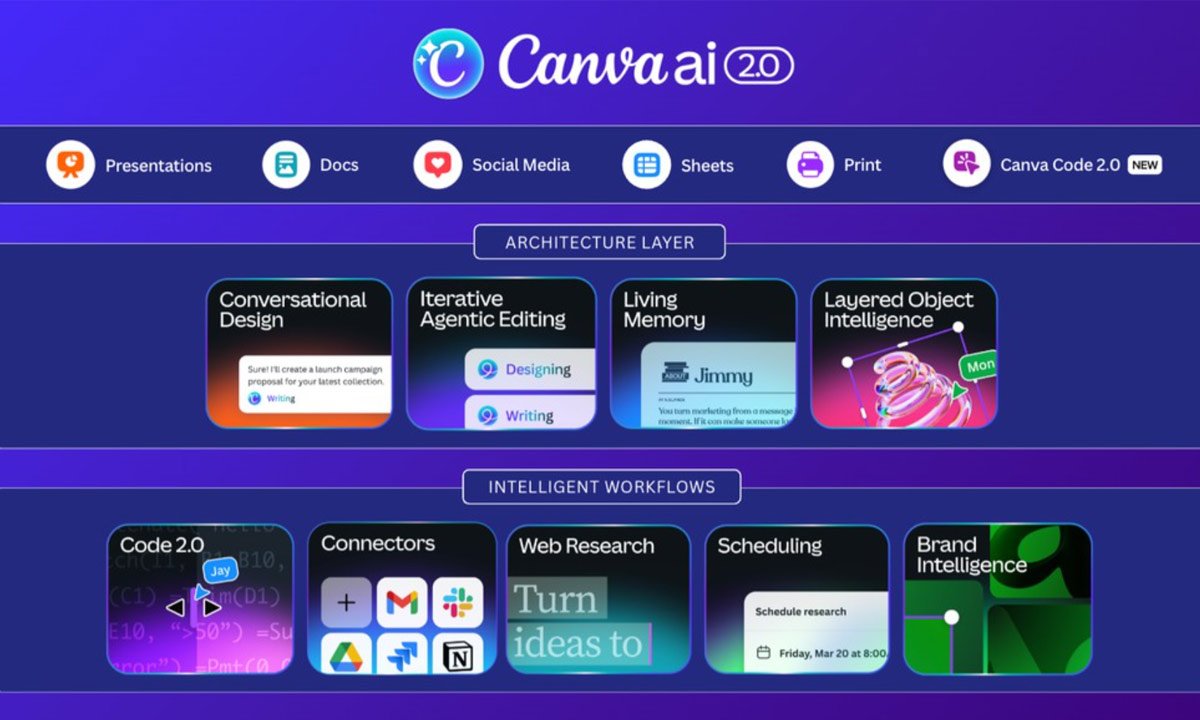
Canva has announced what it describes as the biggest evolution of its platform since its founding in 2013, introducing Canva AI 2.0, a sweeping overhaul that pushes the popular design tool firmly into the era of AI-driven creation. The update positions Canva not just as a design platform but as a broader productivity ecosystem where teams can ideate, create, and execute work within a single interface.
Over the past decade, Canva has grown from a simple online design editor into one of the world’s most widely used creative platforms. The company says more than 250 million people now use Canva every month, largely drawn by its template-based approach and drag-and-drop interface that simplified complex design workflows once dominated by professional desktop software.
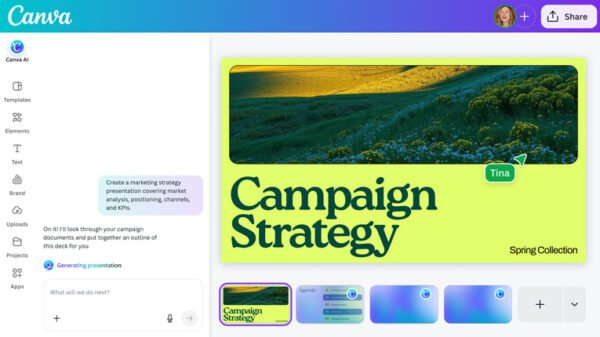
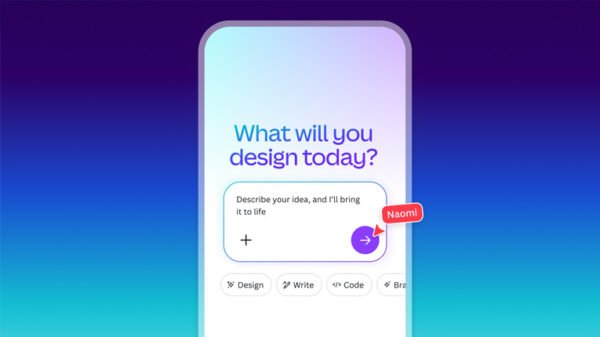
With Canva AI 2.0, the company is now attempting to reimagine how creative work begins and evolves. Instead of starting with a blank canvas or template, users can describe what they want using natural language prompts. Canva’s AI interprets that input and generates an editable design structure, complete with layout, brand elements, and visual hierarchy, that can be refined through conversation.
This conversational design approach marks a significant departure from traditional generative AI tools that typically produce a single output. Canva says its system maintains context throughout the design process, allowing users to iterate, brainstorm, and modify ideas without repeatedly starting from scratch.
At the core of this transformation is what the company calls “Agentic Orchestration.” Rather than relying on separate tools for writing, visuals, data, and presentation, the platform can automatically coordinate Canva’s different features to produce complete outcomes. For example, a user could ask Canva AI to generate a multi-channel marketing campaign and receive assets such as presentations, social posts, and documents that are already aligned with the same visual style and messaging.
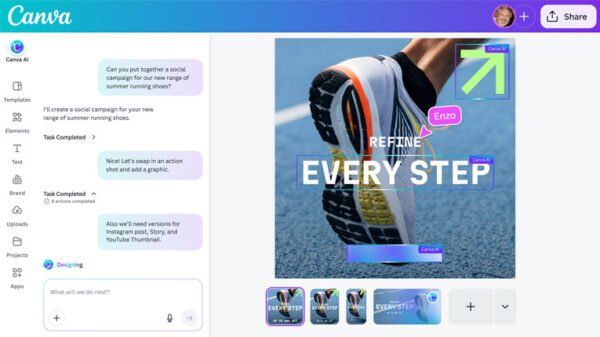
Another major addition is Object-Based Intelligence, which enables granular editing within generated designs. Instead of regenerating an entire design when making changes, users can adjust specific elements, such as replacing an image or altering a headline, while the rest of the layout remains intact. The system maintains layered editability so collaborators can continue refining the design as if it had been built manually in the editor.
The update also introduces Living Memory, a feature designed to personalise the AI experience over time. Canva AI can learn from a user’s past designs, preferred styles, and brand guidelines, allowing the platform to automatically apply consistent fonts, colours, and visual identities across projects.
Beyond design, Canva AI 2.0 expands the platform into broader productivity workflows. Through connectors, users can integrate services such as Slack, Notion, Zoom, Gmail, Google Drive, and Google Calendar. This allows Canva to generate content directly from workplace data, such as turning meeting transcripts into summaries or transforming email threads into sales presentations.
Automation is another focus. With built-in scheduling capabilities, users can instruct Canva AI to perform recurring tasks in the background, for instance, generating weekly batches of social media posts or compiling daily meeting briefings from email and calendar data.
Under the hood, these capabilities are powered by Canva’s frontier AI research lab, which has been developing multimodal foundation models tailored specifically for design workflows. The company claims its proprietary models are significantly more efficient than comparable systems, with some reportedly running up to seven times faster and costing up to 30 times less to operate.
Canva is also expanding its role within the broader AI ecosystem. As part of the announcement, the company revealed deeper integration with Anthropic’s Claude AI, enabling artefacts created in AI chat tools, including Claude and ChatGPT, to be imported directly into Canva and converted into editable designs or websites.
The new AI platform will initially launch as a research preview, rolling out to the first one million users who access it via the Canva homepage starting April 16. Wider availability will follow gradually over the coming weeks.
For Canva, the message behind AI 2.0 is clear: the company is no longer positioning itself merely as a design tool. Instead, it aims to become the central workspace where creative ideas move from concept to finished output, increasingly with AI acting as the collaborator.
2 Comments
Pingback: Canva Can Now Work Offline
Pingback: orlistat vs orlistol