

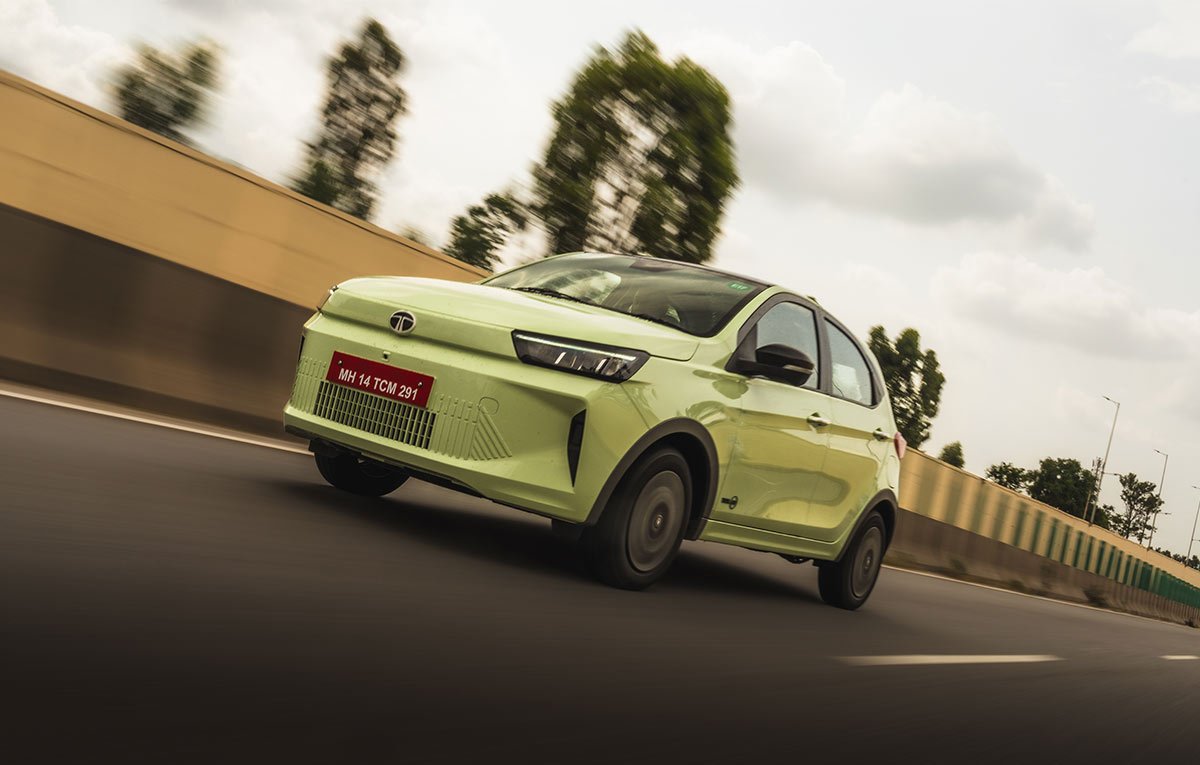
For decades, the phrase “people’s car” has been reserved for vehicles that put mobility within reach of millions. Cars that families aspired to own and that transformed the way a nation moved. As electric vehicles steadily make their way into the mainstream, it raises an interesting question: can an EV ever earn that same title? If there’s one car making a compelling case for it, it’s the Tata Tiago EV. Since its launch, it has done more than simply sell electric mobility; it has introduced thousands of Indians to EV ownership. Now, in its updated avatar, that argument feels stronger than ever. After spending time with the new Tiago EV, the answer seems closer to a yes than it ever has before.
The Tiago EV has always occupied a unique position in India’s electric vehicle landscape. While larger EVs have focused on range, performance, or premium features, the Tiago EV has concentrated on something far more important, which is making electric mobility attainable. With prices starting from ₹6.99 lakh (ex-showroom), it remains one of the most accessible electric cars in the country, and with the latest updates, Tata Motors has strengthened its case significantly.
Looking More Premium Than Ever
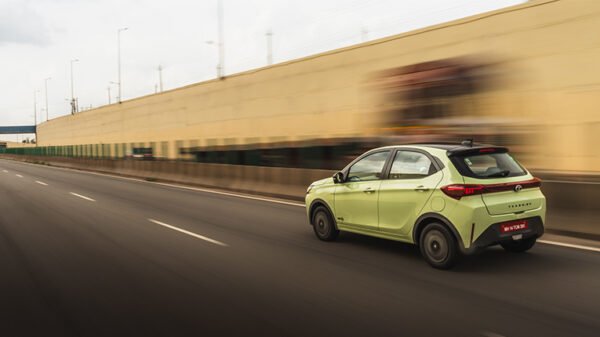
Visually, the updated Tiago looks more mature and contemporary than before. The front end now features sleek Lux Beam LED headlamps, LED DRLs, a wider lower grille, and a cleaner overall design language. At the rear, the connected Halo Lightbar-style tail lamps add a sense of sophistication that was previously unheard of in this segment. New alloy wheel designs, fresh colour options such as Dehradun Dew, Pangong Pulse and Sobo Surge, along with a dual-tone roof on higher variants, help the hatchback punch above its weight. What is particularly impressive is that the Tiago doesn’t feel like a budget car trying to look expensive. Instead, it feels like a genuinely well-designed hatchback that just happens to be affordable.
Tech That Punches Above Its Weight
On the inside, the improvements become even more apparent. The cabin receives a redesigned dashboard, a premium dual-tone interior theme, textured trims and a cleaner layout. The standout feature is the new 10.25-inch HD touchscreen infotainment system paired with a fully digital instrument cluster. Wireless Apple CarPlay and Android Auto, iRA.ev connected car technology with over 40 connected features, automatic climate control, passive entry and start, rear AC vents, cruise control, and 65W Type-C fast charging ports all contribute to an experience that feels surprisingly premium for the price. Better still, Tata hasn’t fallen into the trap of moving every control into the touchscreen.
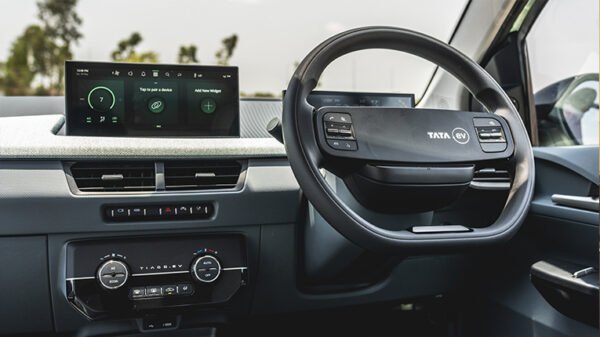
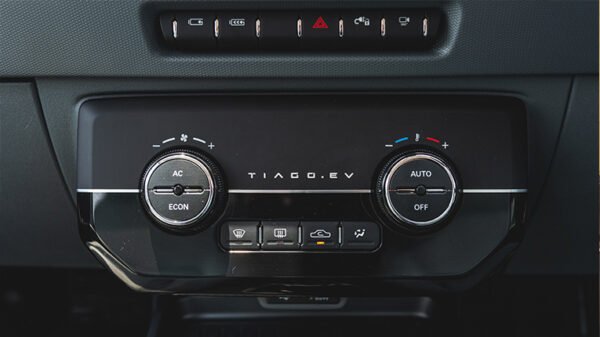
The Tiago EV retains physical buttons and rotary controls for the air-conditioning and other frequently used functions, making them far easier to operate on the move. It’s a small detail, but one that greatly improves everyday usability.
The Heart of the Matter
Of course, the real story lies beneath the sheet metal. The Tiago EV continues to be offered with two battery pack options. Buyers can choose between a 19.2kWh battery and a larger 24kWh battery. The electric motor produces 61bhp and 110Nm in the smaller battery version, while the larger battery variant develops 74bhp and 114Nm. Tata estimates a real-world C75 range of around 160km for the 19.2kWh pack and approximately 205km for the 24kWh version. The larger battery model can also sprint from 0-60kph in just 5.7 seconds. Those numbers may not seem extraordinary on paper, but they feel perfectly suited to urban life.
Also Read: Faster, Safer, Smarter: Anand Kulkarni on the Evolution of the Tata Tiago EV
And while those figures suggest that the Tiago EV is primarily a city car, my drive from Bengaluru Airport to Nandi Hills revealed a broader range of abilities. Whether cruising comfortably at highway speeds, dispatching the occasional overtake, or crawling through slower stretches of traffic, the car felt entirely at ease. The instant torque delivery means overtakes require little planning, while one of the most pleasant surprises was just how quiet the cabin is. With no engine noise to contend with, there’s a sense of refinement that you simply don’t expect at this price point.
Even at highway speeds, road and wind noise are kept reasonably well in check, allowing conversations and music to be enjoyed without having to raise your voice. No, it doesn’t encourage you to seek out twisty roads or chase performance numbers, but that’s not the point. What impressed me most was how naturally it adapted to every situation the route threw at it. It felt just as happy covering kilometres on the highway as it did navigating the urban chaos that awaited at either end of the journey.
Why It Works So Well in the City
Those numbers may not seem extraordinary on paper, but they feel perfectly suited to urban life. And while the Tiago EV’s credentials suggest it’s a city car first and foremost, my drive from Bengaluru Airport to Nandi Hills revealed a broader range of abilities.
Whether cruising comfortably at highway speeds, dispatching the occasional overtake, or crawling through slower stretches of traffic, the car felt entirely at ease. The instant torque delivery means overtakes require little planning, while one of the most pleasant surprises was just how quiet the cabin is. With no engine noise to contend with, there’s a sense of refinement that you simply don’t expect at this price point. Even at highway speeds, road and wind noise are kept reasonably well in check, allowing conversations and music to be enjoyed without having to raise your voice.
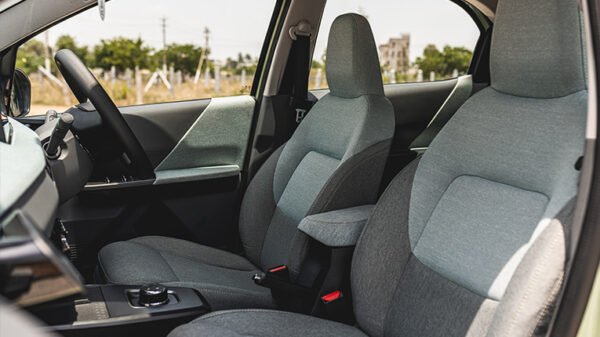
Front-seat comfort is another area where Tata has made meaningful progress. The seats offer firmer back support than before, and the improved under-thigh cushioning makes longer stints behind the wheel noticeably more comfortable. There is also a welcome sense of lumbar support that helps reduce fatigue during extended drives. Combined with the upright driving position and excellent visibility, the Tiago EV is a genuinely pleasant place to spend time in.
However, this is also where the Tiago EV’s claim to being India’s People’s EV begins to face its biggest challenge.
The People’s EV?
If a people’s car is supposed to work for the entire family, the rear seat remains the Tiago EV’s weakest area. While it’s perfectly acceptable for short urban commutes, adults will struggle to find genuine comfort here over longer journeys. Knee room is merely adequate, the seating position isn’t particularly accommodating for taller occupants, and three adults in the back would quickly become an exercise in compromise rather than comfort.
Then there’s the boot. At 240 litres, it’s sufficient for grocery runs, backpacks and everyday errands, but it starts feeling restrictive the moment family travel enters the equation. A weekend getaway with four occupants would require careful packing, and larger suitcases quickly expose the limitations of the available luggage space. In a country where cars often serve multiple roles, from daily commuter to family holiday machine, this is one area where the Tiago EV still reminds you that it’s fundamentally a compact hatchback.
That said, perhaps expecting Nexon-like practicality from a car in this segment misses the point entirely. The Tiago EV isn’t trying to be all things to all people. It’s trying to be an affordable, efficient and easy-to-live-with electric hatchback, and viewed through that lens, its compromises become easier to accept.
Safety Takes Centre Stage
Safety has also received a significant boost. Six airbags are now standard across the range, complemented by electronic stability control, traction control, hill hold assist, tyre pressure monitoring, ISOFIX mounts and Tata’s robust safety structure. Perhaps the most impressive additions are the new 360-degree camera system with multiple 2D and 3D viewing modes, along with a blind-view monitor. Features like these are still rare in this price bracket and genuinely improve everyday usability.
The battery and motor are also protected by IP67-rated sealing, while the larger 24kWh battery pack is backed by a lifetime warranty, adding another layer of confidence for first-time EV buyers.
What About the Petrol and iCNG Versions?
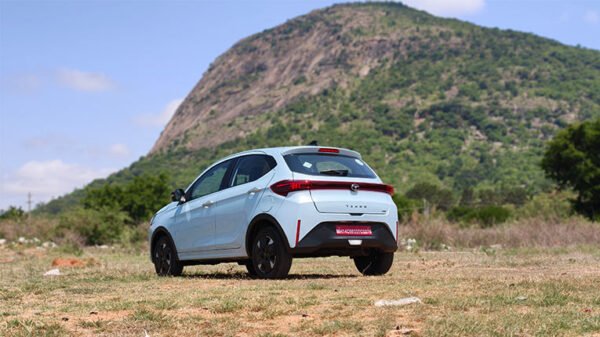
However, the Tiago story isn’t limited to electric power alone. The hatchback continues to be available with petrol and iCNG options as well, reinforcing Tata’s multi-powertrain strategy. The petrol range starts from ₹4.99 lakh (ex-showroom), while the iCNG variants begin from ₹5.99 lakh (ex-showroom), making them attractive alternatives for buyers who aren’t ready to make the switch to electric.
Mechanically, the petrol and iCNG variants remain unchanged. The familiar 1.2-litre three-cylinder engine continues to power both versions, meaning the driving experience remains largely the same as before. They’re practical, easy-to-drive hatchbacks that serve their purpose well. However, they deliver a fundamentally different experience from the EV. The electric version feels quieter, smoother, and more responsive in urban environments, while the petrol and CNG models retain the traditional characteristics of an internal-combustion hatchback.
A Strong Case for the People’s EV
So, is the Tata Tiago EV India’s People’s EV? Not if your weekends involve frequent intercity road trips. Not if your family regularly travels with four adults and luggage in tow. And not if maximum range or outright practicality is your top priority.
But if your life revolves around office commutes, school runs, grocery trips and everyday city driving, it’s difficult to think of another EV that makes a stronger argument. It offers a meaningful range, low running costs, modern technology, impressive safety equipment and a genuinely pleasant driving experience at a price point that many Indian families can realistically consider. The Tiago EV seems to be making a strong case for becoming India’s most sensible EV. And perhaps that’s exactly what a People’s EV should be.